How We Produce Press Junkets and Satellite Media Tours in Spain
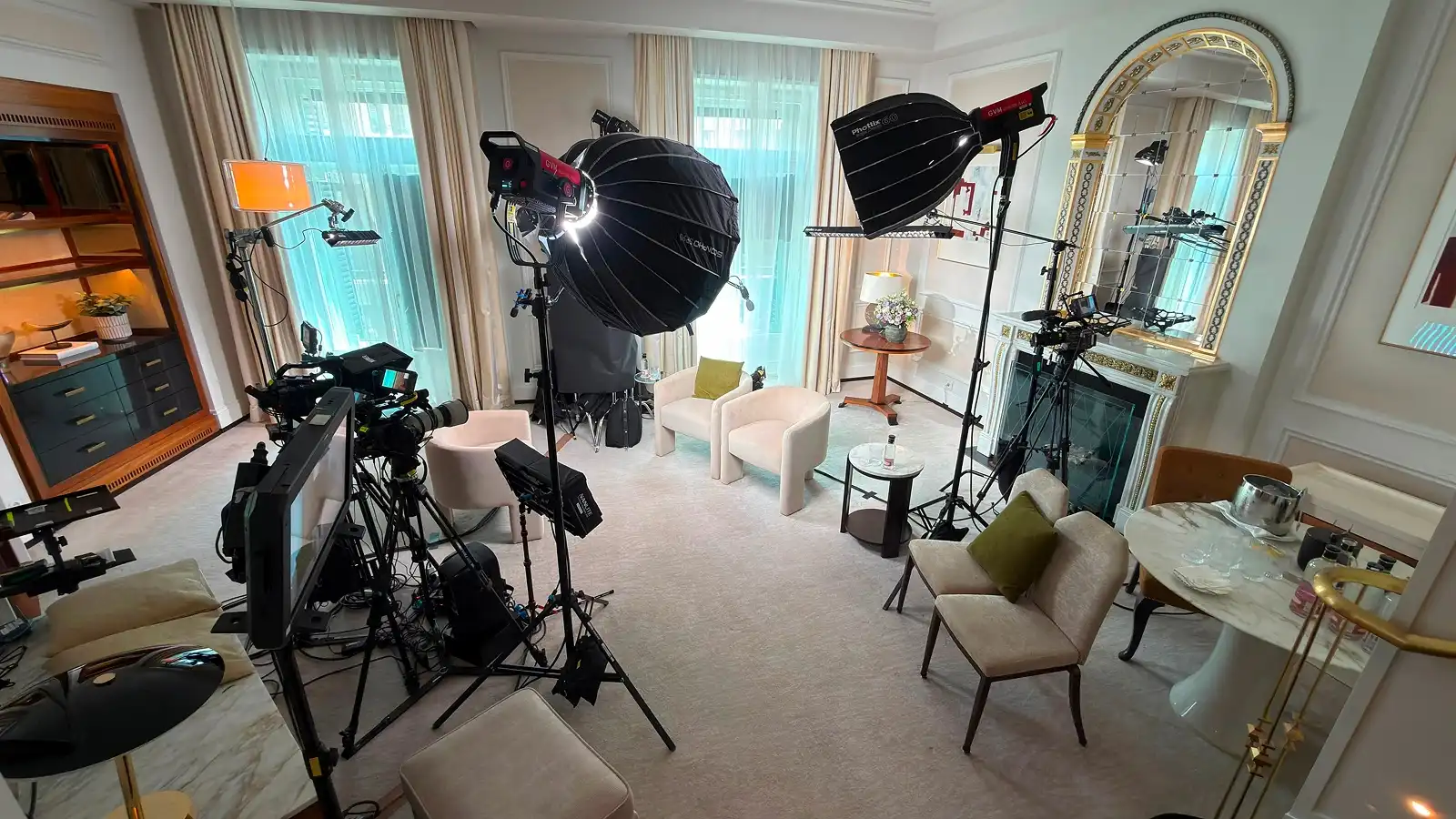
A journalist gets ten or fifteen minutes with an actor promoting a new film, then the next journalist sits down, and the next, same room, same lighting, same camera setup, all day. A press junket is a press event where journalists interview talent or executives in short, back-to-back sessions, usually timed to a film, show, or product launch. It’s one of the highest-volume formats of interview video production in Spain we run. We handle them both ways, virtual over Zoom and live in person, and we’ve pushed a single junket’s feed live to 120 channels at once.
What Is a Press Junket?
Wikipedia covers the general definition well enough, we won’t repeat it here. What’s less written about is the production side: a junket is a controlled environment built for volume. One journalist finishes, the next sits down within a minute, and the set can’t reset between them. Lighting, sound, and camera framing have to survive dozens of turnovers in a row without a single one showing on camera.
Small talent lists usually run as one-on-ones. Long outlet lists switch to roundtables of three or four journalists at once instead. A typical slot runs eight to twelve minutes, tight enough that a delay on interview three costs every journalist after it. That’s why we run a dedicated timer on any list longer than a handful of names.
What Is a Satellite Media Tour?
A satellite media tour is the same back-to-back interview format, built for a brand or corporate spokesperson instead of an actor or director. A CEO, a doctor, an athlete, or a company spokesperson sits in one location and gives a set of short interviews to news and lifestyle outlets. It’s usually tied to a product launch, a health campaign, or a company announcement. The name comes from how the format used to run, over satellite trucks and dedicated feeds, before broadband and bonded cellular made a live internet connection just as reliable. A single spokesperson can realistically get through fifteen or twenty short interviews in a day, aimed at a spread of national and local outlets rather than one big premiere audience.
Press Junket VS Satellite Media Tour
Both formats run on the same production mechanics: one set, one camera package, back-to-back short interviews. What changes is who’s in the chair and who’s asking.
| Press Junket | Satellite Media Tour | |
|---|---|---|
| Who’s interviewed | Actors, directors, showrunners | Executives, spokespeople, experts |
| Who’s asking | Entertainment journalists, film press | News, lifestyle, and trade media |
| Usually tied to | A film, show, or season premiere | A product launch, campaign, or announcement |
| Audience | Fans and entertainment audiences | Consumers, investors, or trade audiences |
Same crew, same cameras, same live transmission setup either way. The difference is entirely in who’s on camera and why. If the story is about a person, it’s a junket. If it’s about a company or a product, it’s a media tour. That one distinction decides what we brief the crew to expect on the day, right down to how formal the set needs to look.
How We Film Press Junkets and Satellite Media Tours in Spain
Every junket or media tour starts with the same three questions: how many interviews, over how many days, and how many need to go out live instead of edited and sent afterward. That shapes everything else, from crew size to which gear comes off the shelf.
For the crew, we bring in English-speaking video crew: camera operators, sound recordists, and a producer who runs the schedule so journalists don’t wait around between slots. On a live tour day, that list grows: a timer keeping every interview on schedule, a streamer watching the feed run. A single-day shoot doesn’t need either role. A multi-outlet live day can’t run without them.
For the set, we pull from our camera and interview setup equipment: multi-camera packages, and lighting compact enough to survive a hotel room or a studio equally well. The room gets the same attention: here’s how we dress a junket interview set so the last interview matches the first. Monitors let a director or agency rep approve every take remotely, even from another country. Delivery goes out however the outlet needs it: a physical memory card, a digital download, or a live feed straight to the broadcast platform.
For transmission, real-time delivery runs through live streaming and broadcast services in Spain, built around bonded connections so a dropped signal in one interview doesn’t take the whole day down. How we transmit live interview feeds matters most on tour days with a dozen outlets waiting on the same stream.
Scheduling is its own discipline. A full day of back-to-back interviews only works with three things confirmed before day one starts: every outlet’s slot, every journalist’s arrival time, and a buffer for the one interview that runs long.
In-Person vs Virtual and Hybrid Press Junkets
Not every outlet can send a journalist to the room, and increasingly, not every outlet wants to. A virtual day runs the same format over a call. A teleprompter rig lets talent see the remote interviewer face to face, not a laptop screen propped on a stand. The interview still plays like a conversation, not a video call.
Hybrid days mix both, some journalists in the room, others dialing in, often on the same schedule. It’s usually a scheduling reality more than a creative choice: some outlets are already covering an event in Madrid that week, others can’t justify the travel for fifteen minutes of tape. The camera work isn’t the hard part. Keeping a live feed steady enough that a remote journalist gets the same broadcast-quality result as the one sitting three feet from the talent is. Bonded cellular transmission is what makes that possible without a satellite truck or a fixed line on site.
Press Junket and Satellite Media Tour Production Cost in Spain
Cost comes down to four things: how many cameras, how many shoot days, how many interviews go out live, and how far outside a major city the location sits.
A single-camera virtual day is the lightest lift: one operator, one room, one feed out. Add a second or third camera for a proper interview architecture, multiple shoot days, or a live stream to dozens of outlets. The crew grows to match: additional camera operators, a dedicated streamer, a timer keeping the schedule. A minimal virtual day runs with a camera operator and a producer. A three-camera live tour adds a second and third operator, a sound recordist, a timer, and a streamer, six roles instead of two.
Location matters more than people expect. A hotel or studio in Madrid or Barcelona keeps crew travel and overnight costs down. A location further out adds a day rate for travel time alone, before a single camera rolls.
A two-person virtual day and a three-camera, three-day tour live to 120 channels are not the same quote, and treating them as one flat rate would undersell the bigger job or oversell the smaller one. Get a detailed quote once you know the format, the day count, and how many interviews need to go out live, and we’ll size the crew to match.
Recent Work: Apple TV+ Dark Matter Season 2 Press Junket in Madrid
The clearest example of this in practice: our Apple TV+ Dark Matter Season 2 press junket in Madrid this August. Jennifer Connelly and Joel Edgerton ran a full junket out of a single hotel room: three cameras, two actors side by side, and a third camera on the journalist. Day one ran entirely virtual over Zoom. Three Sony FX6s carried the interview architecture, with a teleprompter and HDMI-to-Zoom rig handling the virtual day and an Atomos monitor on each camera for on-set confidence checks. Days two and three went live to 120 channels, most of them in the US, with zero dropped feeds across either day.
Real press coverage followed. Joel Edgerton spoke to outlets covering the tour about AI, in an interview recorded on that same three-camera setup, two days before the season premiered. That’s the kind of reach a well-run junket can carry past the interview room.
It’s the same production logic covered above, camera architecture, crew, and transmission, just scaled up to a level most junkets never reach.
Press Junket Production FAQs
What companies organize press junkets in Spain?
We do, alongside a handful of Madrid and Barcelona based crews. Most international productions bring their own producer and use a local company like ours for crew, camera, location, and live transmission rather than building a Spain-based team from scratch.
Do you handle virtual or hybrid press junkets?
Yes. We run fully virtual days over Zoom with a teleprompter rig, fully in-person days, and hybrid days that mix both on the same schedule, often within the same week.
What’s the difference between a press junket and a satellite media tour?
A press junket puts entertainment talent in front of entertainment journalists, usually for a film or show. A satellite media tour puts a brand spokesperson or executive in front of news and trade media, usually for a product or announcement. The camera setup and crew are nearly identical either way.
How much does a press junket cost to produce?
It depends on camera count, shoot days, and how much of it goes out live. A single-camera virtual day costs far less than a multi-camera tour streaming live to dozens of channels. Get a detailed quote once you know the format and we’ll size it accurately.