Interview Set Design for Corporate Video: How We Dress the Set

Written by: Markus Ruf | Founder & Head of Production
Solving production challenges across Spain since 2008
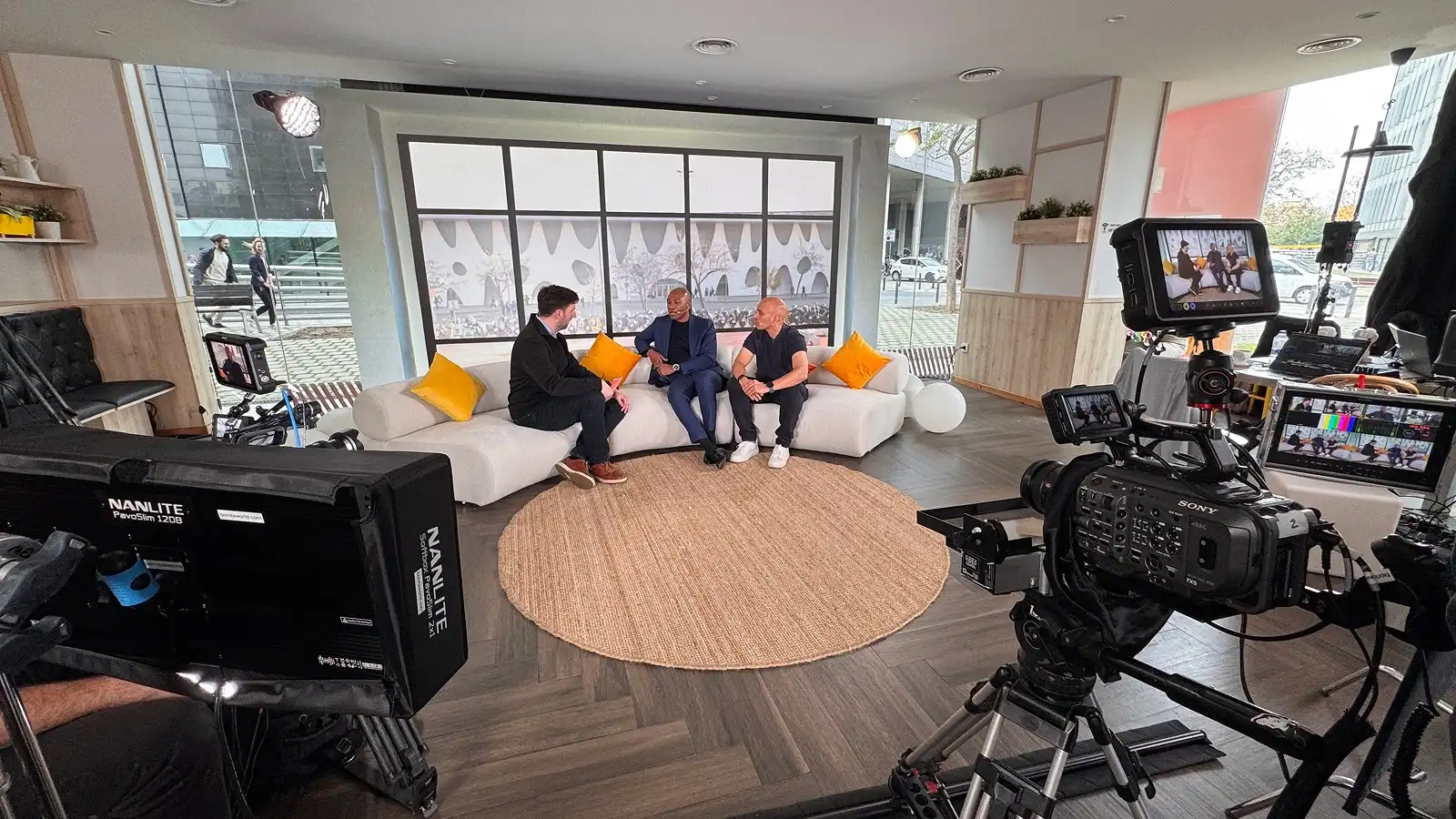
Nobody watches a CEO interview and thinks about the chair. People only notice the set when it’s wrong: a fire exit sign over the shoulder, a tangle of cables behind the plant, a logo cropped in half by someone’s head. Interview set design is the planning and dressing of the space around an interview subject: the backdrop, the furniture, the props and the branding that sit in frame for every second of the video.
Get the interview setup right, and nobody notices it. On the corporate video production in Spain we run, we decide it the week before the shoot, not on the morning of.
Set Design, Set Decoration, Set Dressing: What’s the Difference?
The three terms come from film, and on a feature they belong to three different people. Set design is the plan: the layout, the built elements, the colour palette and what the camera sees. Set decoration is the shopping list: which sofa, which lamp, which plants, sourced from where. Set dressing is the physical work of placing all of it on set and keeping it identical between takes.
| Set design | Set decoration | Set dressing | |
|---|---|---|---|
| What it covers | Layout, backdrop, built elements, colour palette | Choosing and sourcing furniture, plants, rugs, art and props | Placing every item on the day, keeping continuity between takes |
| Film credit | Production designer or set designer | Set decorator | Set dresser |
| On a corporate interview | Floor plan and backdrop agreed with the client | Furniture and branding sourced locally | Set built before the spokesperson arrives, reset between interviews |
A two-camera corporate interview doesn’t get three departments. One producer and the crew cover all three, working from the client’s brand guidelines. The terms still matter, though. When an agency brief says “set dressing included,” it means someone is responsible for the plant sitting in the same spot on interview twelve as it did on interview one.
Why the Set Matters in a Corporate Interview
In a medium close-up, the corporate interview background still fills most of the frame. That makes it the second loudest thing in the video after the person talking, and in corporate work it’s the part the brand team checks hardest. A marketing director will forgive a slightly soft focus pull. A competitor’s product on a shelf behind the CFO, not so much.
The set also does jobs the audience never sees. A rug under the chairs, a sofa and some curtains take the edge off a glass meeting room’s echo before the sound recordist has to fight it. A background with real depth, a lamp three metres back and a plant off to one side, lets the camera separate the subject from the wall without an extra light. Good set dressing makes the sound, the lighting and the edit easier. Bad set dressing makes all three harder.
Interview Set Design by Format
The format decides the set. A CEO message filmed once in an office has almost nothing in common with a media day running back-to-back interviews, and neither looks like an interview corner on a trade show floor.
Executive and CEO Interviews
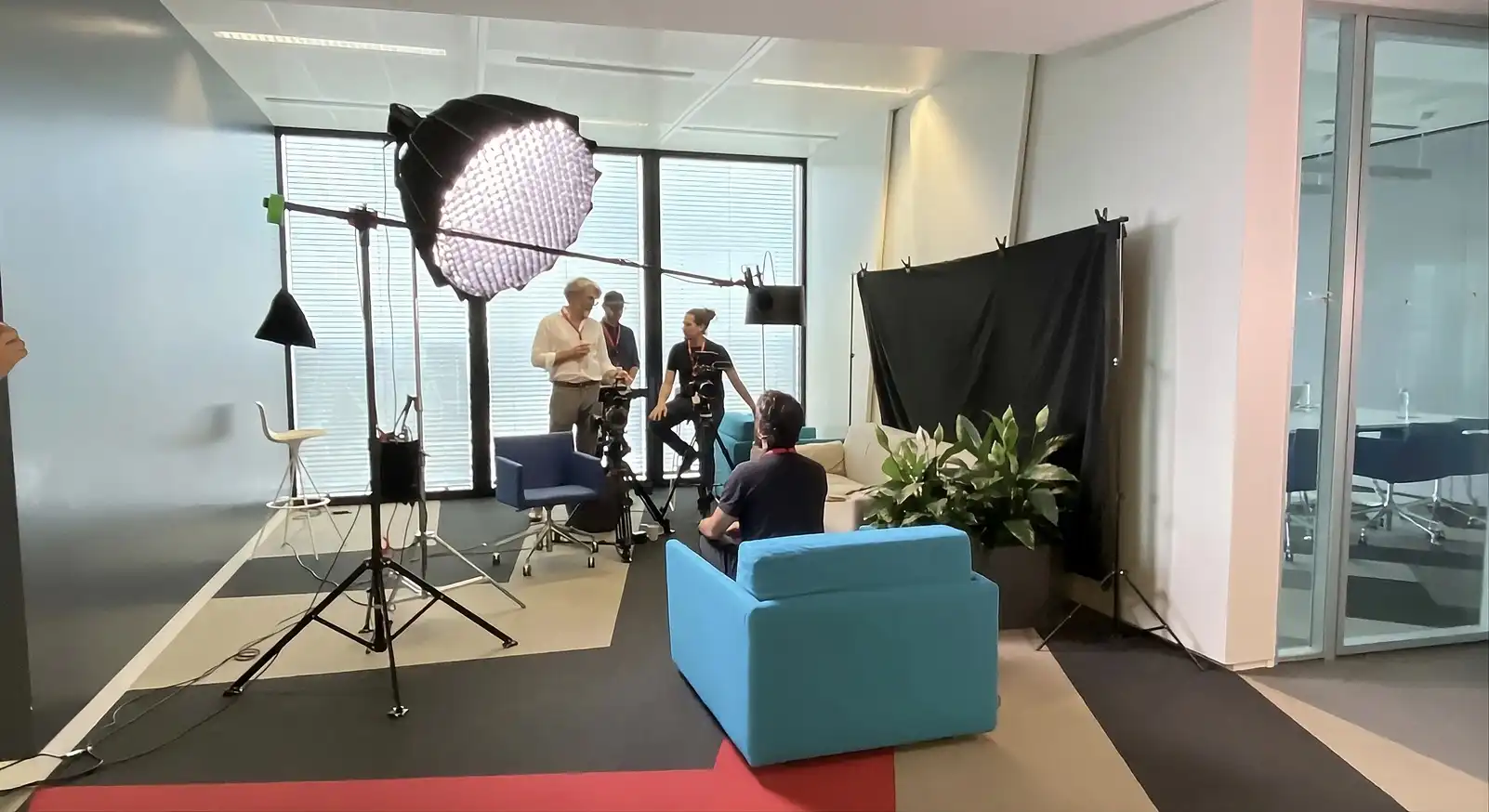
Most executive interviews happen in the executive’s own building, so the job is editing a room rather than building one. We clear what doesn’t belong: whiteboards, spare monitors, cable trays, anything with a date on it. Then we add back what gives the frame depth: a lamp, books with neutral spines, a plant, sometimes the company’s own product placed where it reads without shouting.
For our interview with CEPSA CEO Maarten Wetselaar at the company’s Madrid headquarters (CEPSA has since rebranded as Moeve), the set had to work inside a real executive office. Teleprompter, discreet lighting, and a compact camera setup, all without disrupting a working floor. The office stayed an office. It just looked calmer on camera.
Press Junkets and Media Days
A junket set has one extra requirement: it has to survive. Talent sits in the same chair all day, journalists rotate every eight to twelve minutes, and the frame on the last interview has to match the first. That means furniture that doesn’t creak, branding fixed so it can’t drift, and a reference photo of the dressed set taken before the first journalist sits down.
Junkets often run in hotel suites, where set design is mostly the art of hiding the hotel. The branding, usually the show’s key art or the product itself, comes from the client. We place it, secure it and light it. How we run press junkets covers the camera and scheduling side of the same setup.
Trade Show and Conference Interview Stations
This is where interview set design earns its place on the quote. A conference interview station has to look like a calm studio while sitting in the middle of the loudest room in the city.
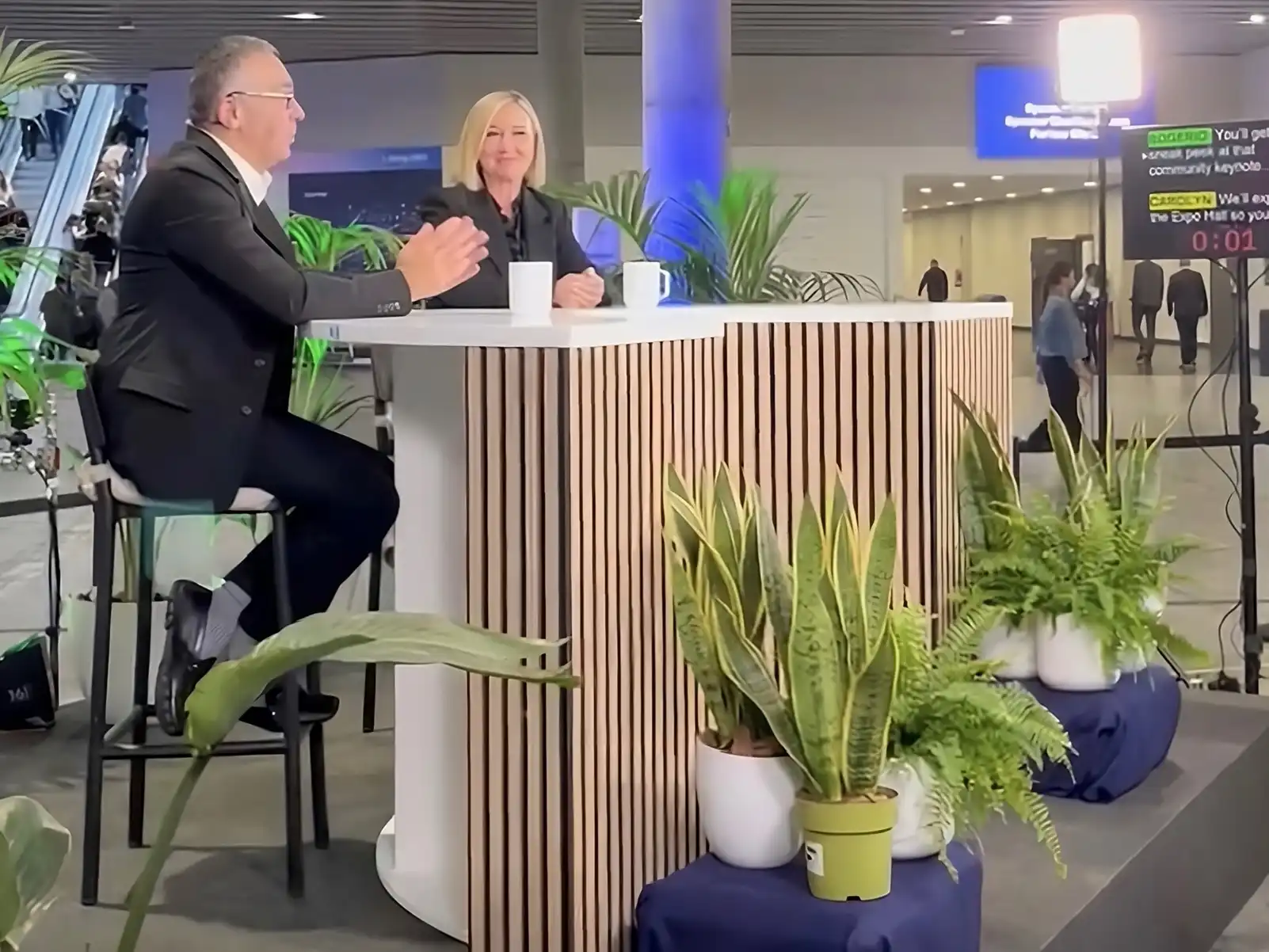
At FYUZ 2023 at IFEMA Madrid, the station was a 5 × 4 metre carpeted area with the show floor as its backdrop. A rope-and-post perimeter defined the space without walling it off from the exhibition. Bar stools and tall tables kept the conversation at standing height and gave the cameras cleaner angles, and flowers softened the frame without getting in the way of the gear. Over three days, that set hosted speakers from AT&T, Deutsche Telekom, Nokia and Vodafone.
For VMware Explore Barcelona the approach went the other way. A portable green screen kept the branding consistent across every interview, and the station was set up identically three years running, from 2021 to 2023. Footage from the first year still cuts with footage from the third. Same set, same light, three years.
Green Screen and Virtual Sets
Sometimes the right set is no set at all. Green screen lets the background be decided in post: a branded environment, an animated backdrop, a location you couldn’t physically film in. We built green screen studios inside FC Barcelona’s training facilities for ESPN at FC Barcelona, interviewing Messi, Xavi, Puyol and Fàbregas in slots of 20 minutes per player.
The trade-off is that the set design work doesn’t disappear; it moves. Someone still has to design the virtual set, and the light on the subject has to match the background it will be keyed into.
How to Design an Interview Set, Step by Step
Every interview set we build follows roughly the same sequence, whether it’s a boardroom in Madrid or an exhibitor stand at MWC Barcelona.
- Read the brand guidelines first. Colours, logo clear space, anything the brand never shows. It decides half the shopping list before anyone opens a catalogue.
- Walk the space or get a floor plan. Ceiling height, windows, power points, and how far the subject can sit from the back wall. Depth is the one thing you can’t add in post.
- Pick the interview backdrop. A real location, a dressed office, a printed branded backdrop, fabric, or green screen. Each one changes the lighting plan.
- Choose furniture for the format. Armchairs for a long sit-down, bar stools for a standing trade show conversation, nothing that squeaks for a full junket day.
- Source the decoration. Plants, lamps, rugs, books, product. Sourcing locally in Madrid or Barcelona beats shipping props across Europe for a one-day shoot.
- Place the branding. Logo visible in the wide shot, out of the way in the close-up, never cropped by the subject’s head.
- Light the set, not just the subject. Practical lamps in frame, a touch of colour on the back wall, clear separation between subject and background. Good interview lighting treats the background as part of the shot, not an afterthought.
- Photograph the finished set. It’s the continuity reference for every reset between interviews and across days.
- Strike clean. Hotels, offices, and venues all expect the room back exactly as they gave it to you.
Trade Show Interview Sets: Building on Someone Else’s Stand
You know how an exhibition stand looks perfect in the render and slightly chaotic by ten on the first morning? That’s the environment an interview set has to live in at a show like Mobile World Congress in Barcelona. We’ve been filming MWC Barcelona since 2008, for clients including HP, Microsoft, Samsung and Nvidia, and the set problems are always the same three.
The stand belongs to the stand builder. The interview corner, its power, its backdrop wall and its lighting positions have to be agreed with them before build-up. Nobody moves a wall on the morning the doors open.
The show floor never stops. Hall announcements, a neighbouring stand’s demo reel on loop, visitors walking through the back of the frame. Soft furnishings, careful camera angles and directional microphones solve most of it.
Space costs money. Exhibitors pay for every square metre, so the interview set usually has to work in a corner a fraction of the size of a studio. Smart exhibitors book the interview corner at the same time as the stand, not after.
When the stand can’t spare the space, the answer is a private set: a meeting room or suite dressed as a small studio, away from the floor noise. The brand is carried by the backdrop and furniture instead of the stand. We’ve run both setups at MWC, on the exhibition floor and in private rooms, as part of our wider event video coverage at Fira Barcelona and IFEMA Madrid.
Who Handles the Set on a Corporate Shoot?
There are three usual answers. Some brands send their own agency art director with a finished set design, and we build and light to it. Exhibitors sometimes ask their stand builder to add an interview corner, which works when the builder knows what a camera needs. A glossy white wall under show lighting is the classic result when they don’t.
The third answer, and the one we see most often, is folding the set into the production itself. That’s how we handle most interview production in Spain. Furniture, plants, backdrops and printed branding are sourced locally, the set goes up before the crew rigs the lights, and it comes down after the last interview. One quote, one call sheet, one team responsible for everything in frame.
Your CEO sits down. The set is already there. Get a detailed quote with the format, location and dates, and we’ll include the set in it.
Related FAQs
What makes a good interview backdrop?
A good interview backdrop has depth and nothing that competes with the speaker. A lamp a few metres back, a plant off to one side, and branding placed where the subject’s head can’t crop it will do more than any printed wall. The two most common mistakes are a flat white wall, which looks harsh on camera, and busy shelves that pull the eye away from the person talking.
How far in advance should an interview set be planned?
For an office interview, a few days is usually enough. For a trade show or a multi-day junket, plan the set alongside the stand design or the hotel booking, because printed backdrops need production time and stand layouts lock early.
Can you build an interview set on a trade show stand at MWC Barcelona?
Yes. We agree the interview corner, power and backdrop with the stand builder before build-up, then dress and light it for the show days. When the stand has no room to spare, we set up a private interview set in a meeting room or suite instead.
What is the difference between set dressing and set decoration?
Set decoration is choosing and sourcing what furnishes a set: furniture, plants, rugs, artwork. Set dressing is physically placing it on set and keeping it in the same position between takes. On a film they’re separate roles. On a corporate interview, one team usually does both.
What is interview set design?
Interview set design is planning and dressing the space around an interview subject: the backdrop, furniture, props and branding, and how they sit in the camera frame. On corporate shoots it usually covers set design, set decoration and set dressing in a single job, handled by the production crew.