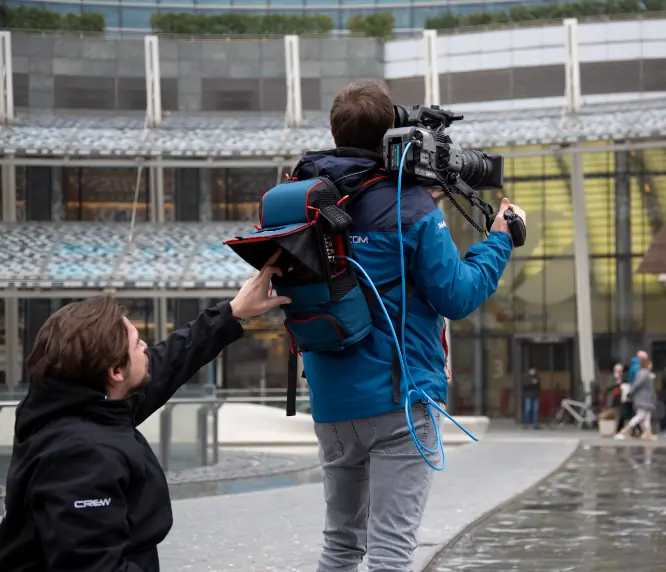
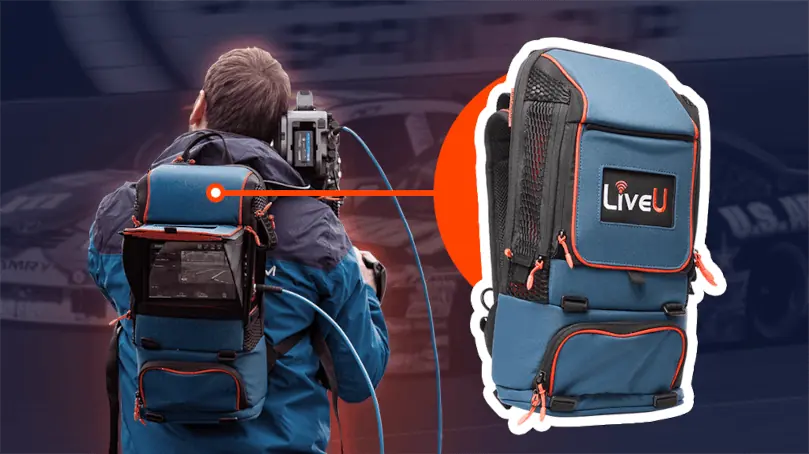
If you’ve ever wondered how ENG crews broadcast live from remote locations without a satellite truck, or how sports productions maintain reliable streams from venues with terrible WiFi, the answer is often LiveU.
LiveU is a bonded cellular transmission system that lets broadcast crews send high-quality video from virtually anywhere with cellular coverage. Instead of relying on a single internet connection that might drop at the worst moment, LiveU combines multiple cellular signals into one reliable stream.
For production managers planning shoots in Spain or anywhere else, understanding when LiveU makes sense versus when standard internet will do can save you money and prevent transmission disasters.
Why LiveU Was Invented: The ENG Crew Problem
The Early-2000s Challenge: Getting Live Video From the Field
LiveU came out of a specific problem facing news crews in the early 2000s when getting video from the field back to the station meant either:
Satellite Uplink Trucks: Expensive, slow to deploy, require a clear sky view, and cost thousands per day. Not practical for breaking news or multiple daily live shots.
Microwave transmission: Limited range, requires line of sight to a receiver truck, doesn’t work in most urban environments with buildings blocking signals.
Venue internet or WiFi: Unreliable, often overloaded during events, subject to venue IT policies and restrictions.
News directors needed a solution that was portable, quick to set up, and worked from locations where traditional broadcast infrastructure didn’t exist. Bonded cellular solved this by turning consumer mobile networks into a broadcast transmission path.
Why Bonded Cellular Was the Breakthrough
The technology proved so effective for news that it quickly expanded to other production types: sports coverage from venues with poor connectivity, corporate events, documentary filming in remote locations, and any situation where you need reliable video transmission without infrastructure.
How LiveU Works: Bonded Cellular Explained
The core concept is straightforward: don’t put all your eggs in one basket.
Traditional live streaming relies on a single internet connection. If that connection stutters, your stream stutters. If it drops, you’re off air. LiveU takes a different approach by using multiple cellular modems simultaneously, typically 4-8 SIM cards from different carriers.
Here’s what happens: your video signal splits into small data packets sent across all available cellular connections simultaneously. Some packets travel on Movistar’s network, others on Vodafone’s, others on Orange’s. LiveU’s servers reassemble everything into a smooth stream at the receiving end.
The intelligence is automatic. When one carrier’s signal weakens, LiveU shifts more packets to stronger connections. If a connection drops completely, the other modems compensate. You get stable transmission even when individual cellular signals are unreliable, creating the consistent throughput that broadcast video requires but single connections rarely deliver.
Source: https://www.liveu.tv/
Real-World Problems LiveU Solves
The Venue Wi-Fi Disaster
You’re producing a corporate conference at a Barcelona hotel. The venue promises “high-speed internet throughout.” You arrive to find 500 attendees all connected to the same network, streaming social media, and checking email. Your live stream needs 5-10 Mbps upload consistently. The venue WiFi delivers 2 Mbps at times and drops to zero when the keynote speaker takes the stage.
With LiveU, you’re not dependent on venue infrastructure. Your bonded cellular connection bypasses the overloaded WiFi entirely.
The Festival Streaming Challenge
A music festival production in Valencia. You need to stream interviews and performances from multiple stages across a large outdoor site. No wired internet, spotty WiFi coverage, and thousands of attendees congesting cellular networks.
LiveU’s multiple carrier approach means when one network slows under load, you’re still transmitting on three others. The show continues.
The Breaking News Scenario
A news crew needs to go live from a developing story. No time to deploy satellite trucks, no infrastructure at the location, just the need to broadcast within minutes of arriving.
LiveU units can transmit broadcast quality in the time it takes to turn on the camera and frame the shot.
The Remote Documentary Location
Filming in rural Andalusia for a travel documentary. Beautiful locations, zero infrastructure. You want to send dailies back to your editor in London without waiting until you return to the nearest city.
Cellular coverage exists even where WiFi doesn’t. LiveU works from locations where traditional broadcast solutions simply aren’t possible.
When to Use LiveU (and When Not To)
Situations You Probably Need LiveU
You’re broadcasting live from an event venue where you can’t control the internet infrastructure
Multiple locations need to transmit simultaneously during the same production
You’re filming in remote areas without reliable wired internet
Your production budget can’t absorb the risk of transmission failure
You need broadcast-quality reliability for live streaming services that matter to your client’s business
You’re filming news, sports, or event coverage where going off-air isn’t acceptable
When You Can Probably Skip LiveU
You’re in a controlled studio environment with dedicated internet
You’re recording packages for later editing rather than transmitting live
Your streaming requirements are casual (internal company meetings, social media streams where occasional stuttering is acceptable)
Budget is extremely tight, and you’re willing to accept reliability risks
You have time to test venue’s internet thoroughly before the production date
The Middle Ground: Using LiveU as a Backup
Some productions use LiveU as backup. Primary transmission goes over venue’s hardline internet, but LiveU provides automatic failover if that connection drops. This approach works well for corporate events where stakeholders care about reliability, but venue infrastructure might be adequate.
Is LiveU Worth It? Costs, ROI, and Alternatives
The question comes down to risk versus cost. What happens if your transmission fails during the critical moment of your production? For live broadcasts, the answer is usually disaster. For less time-sensitive content, you may be willing to accept that risk.
LiveU moves video transmission from “cross your fingers and hope” to “engineered reliability”. It’s not perfect, but it’s dramatically more dependable than single-connection solutions when infrastructure is questionable or non-existent.
Productions that require a reliability budget for LiveU. Productions with tight budgets accept more risk. The technology has become industry standard for broadcast news and high-stakes live events precisely because it delivers when failure isn’t acceptable.
Source: https://www.liveu.tv/
Professional LiveU Support in Spain
In Camera Crew Spain, we maintain 10 LiveU units for productions throughout Spain, equipped with Spanish carrier SIM cards optimized for coverage in major cities and regions where international crews typically film.
When international production companies book our live streaming services, they get crews who understand both the technology and Spain’s cellular landscape. Our operators know which Barcelona locations have strong coverage, where Madrid’s networks get congested, and how Valencia’s convention center performs.
Our interview production and ENG crews travel with LiveU equipment included, so documentary and news teams get immediate transmission capability without international equipment shipping. For multi-camera productions, we deploy multiple synchronized units with technical directors who manage the LiveU control interface.
We handle carrier relationships and data plans, eliminating the need for international productions to negotiate with Spanish telecom providers. Our webcast crews scout locations days before your shoot to test signal strength and pre-configure optimal transmission settings, removing uncertainty on production day.
If you’re planning a shoot in Spain and want to remove transmission risk, reach out to us! Share your location(s) and dates, and we’ll tell you what to expect and provide the simplest LiveU setup to keep you on-air.
This website uses cookies so that we can provide you with the best user experience possible. Cookie information is stored in your browser and performs functions such as recognising you when you return to our website and helping our team to understand which sections of the website you find most interesting and useful.
3rd Party Cookies
This website uses Google Analytics to collect anonymous information such as the number of visitors to the site, and the most popular pages.
Keeping this cookie enabled helps us to improve our website.
Please enable Strictly Necessary Cookies first so that we can save your preferences!