Interviews are the backbone of documentary, corporate video, and branded content. Unlike run-and-gun action shooting where you’re chasing the moment, interview video productions give you something rare: control. Your subject sits still, the lights stay put, and the camera doesn’t need to track a moving target.
That controlled environment changes what matters in a camera:
You need reliable autofocus that locks onto eyes and doesn’t hunt mid-sentence.
You need natural skin tones that don’t make your CEO look like they just returned from a spray tan.
You want enough depth of field control to separate your subject from the background without turning them into a blurry mess.
Here’s what we’re using and recommending in 2026, broken down by budget.
Budget Cameras: Under $1,000
At this price point, you’re getting genuinely impressive image quality. The trade-off is usually overheating during long takes or missing features you won’t notice until you need them.
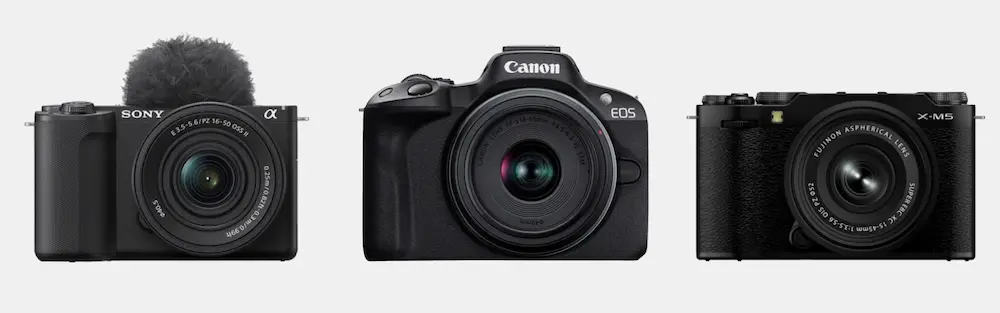
Sony ZV-E10 II, Canon EOS R50, Fujifilm X-M5
Sony ZV-E10 II
Sony’s Eye AF remains the benchmark at this price: it locks on and stays put. The 10-bit recording gives colorists actual latitude to work with. Watch for overheating in 4K 60p after 20-30 minutes, but standard 24p/30p interviews run without issues.
Canon EOS R50
Canon’s color science does the heavy lifting. Skin tones look natural straight out of the camera, which matters for fast turnarounds. The 4K cap at 30fps limits slow-motion B-roll options, but for standard talking heads, it delivers.
Fujifilm X-M5
The dark horse. Fujifilm’s 6.2K Open Gate solves a growing problem: shooting once for both horizontal and vertical delivery. Pull a 4K horizontal and a high-res 9:16 vertical from the same footage. Autofocus isn’t Sony-level, but if your client needs YouTube and TikTok from one interview, this camera earns its keep.
Mid-Range Cameras: $1,500 – $2,500
This is where reliability stops being a compromise. These cameras were built for people who can’t afford equipment failures.
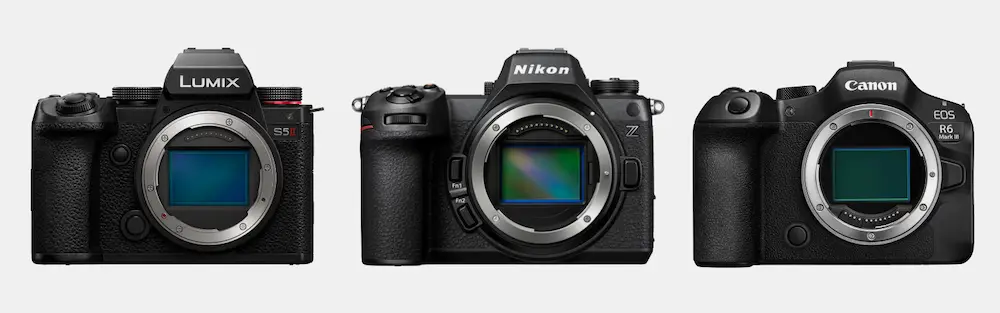
Panasonic Lumix S5II, Nikon Z6 III, Canon EOS R6 Mark III
Panasonic Lumix S5II / S5IIX
The active cooling fan is the story here. This camera records indefinitely in 4K and 5.9K without overheating – even in hot Spanish summers. Phase Hybrid AF now tracks as reliably as the competition. The S5IIX adds direct SSD recording, so your editor can start cutting while you’re still wrapping.
Nikon Z6 III
The partially stacked sensor delivers fast readout speeds, reducing rolling shutter when subjects gesture enthusiastically. Internal 6K RAW gives colorists maximum flexibility. Thermal endurance falls slightly behind the Panasonic in hot environments, but for controlled studios, it’s exceptional.
Canon EOS R6 Mark III
Canon’s autofocus transitions feel organic: focus racks mimic how a human operator would pull focus. The 33MP sensor captures more detail than 24MP competitors, useful when clients want to punch in for tight close-ups. Color science remains Canon’s strength for minimal grading workflows.
Professional Cameras: from $4,000
At this level, the camera becomes transparent. You stop thinking about equipment limitations and focus entirely on craft. This is the tier we work with daily at Camera Crew Spain: both the FX3 and FX6 live in our kit, ready for every interview project that comes through.
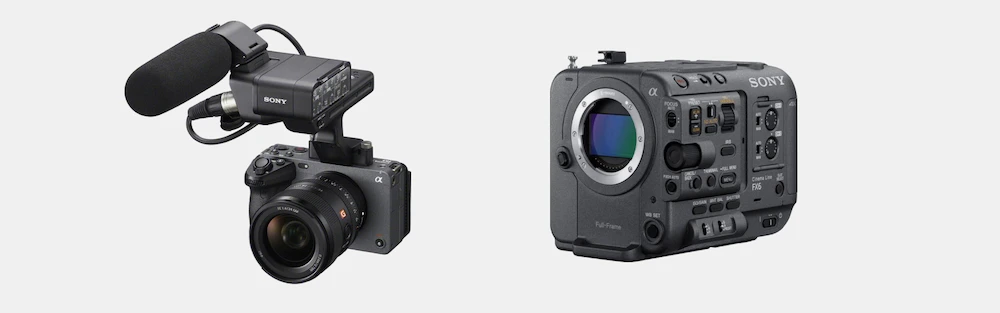
Sony FX3, Sony FX6
Sony FX3
Our go-to for interview work that needs cinema credentials in a compact body. The integrated XLR handle means one less external recorder to manage. Sony’s S-Cinetone delivers a pleasing image that matches seamlessly with higher-end Sony cinema cameras.
Sony FX6
The step up when you need proper cinema camera reliability. Dual Base ISO at 800 and 12,800 handles any lighting scenario, and over 15 stops of dynamic range means recovery latitude budget cameras can’t match. This is what we deploy when the client can’t afford technical compromises.
For a deeper technical comparison of where each camera excels, we’ve written a detailed breakdown in our Sony FX6 vs FX3 vs FX9 guide.
Our Default Interview Setup
When clients book us for interviews across Spain, we show up with a minimum two-camera configuration: FX6 as the A-camera on the main angle, FX3 as B-camera for the tighter or offset shot.
Why two cameras? Single-camera interviews limit your editor. Every cut becomes a jump cut unless you’re punching in digitally (which costs you resolution) or covering with B-roll (which you may not have). Two angles give your editor freedom to cut on content rather than technical necessity.
The FX3 and FX6 share the same color science, so matching footage in post takes minutes rather than hours. Both record to the same media formats, simplifying the workflow from set to edit suite.
For high-profile interviews or documentary work, we’ll add a third angle or dedicated B-roll camera. But two cameras remains our baseline. It’s the setup that consistently delivers professional results without overcomplicating the shoot. You can see this approach in action in our Olympic Channel and Eurosport athletes documentary series.
Interview Production Tips
The camera is just one piece of the puzzle. Here’s what separates amateur interview footage from professional results:
Audio: Lav vs Boom
Use both when possible. A boom captures natural room tone and handles unexpected movements. A lavalier provides backup and consistency.
Here’s what most guides won’t tell you: boom mics can intimidate subjects who aren’t used to being on camera. That big microphone hovering just out of frame makes some people self-conscious, which shows in their delivery. For executives or first-time interviewees, a discreet lavalier often produces better performances simply because they forget they’re being recorded.
If you’re running solo and must choose one, go wireless lavalier.
Pro tip: Always monitor your audio through professional headphones during the shoot. Check levels, listen for interference or clothing rustle, and catch problems before they ruin a great take. Better safe than sorry, there’s no fixing a corrupted audio track in post. Here you can find a very good overview about top best studio monitor headphones.
Lighting
One large softbox at 45 degrees from your subject handles most interview scenarios. Add a grid to control spill in tight spaces.
The biggest amateur mistake is flat, shadowless lighting. A little contrast adds dimension and keeps faces from looking like passport photos. You’re not trying to eliminate shadows: you’re trying to control where they fall.
Camera Height
Position the camera at or slightly above eye level. Shooting up at someone makes them look aggressive; shooting down makes them look weak. Interview credibility comes partly from this subconscious visual cue.
B-Roll Planning
Capture hands, reactions, and environmental details before or after the interview proper. These shots save editors from awkward jump cuts and give your final piece visual variety. If you’re shooting Open Gate, remember you can pull both horizontal and vertical B-roll from the same clips.
Lens Choice Matters
For interviews, an 85mm equivalent lens on full-frame (or 50mm on APS-C) flatters facial features through gentle compression while providing enough background separation. Going wider than 35mm equivalent starts introducing unflattering distortion; going longer than 100mm makes the shot feel distant and disconnected.
A fast aperture (f/1.8 to f/2.8) gives you that creamy background blur, but don’t shoot wide open unless your autofocus is rock solid. One f-stop up gives you the depth of field safety margin to handle subjects who lean forward during emotional moments.
Recording Format Considerations
For interviews destined for broadcast or high-end corporate use, shoot 10-bit if your camera supports it. The extra color data becomes visible the moment you start color correcting, especially when matching footage between different camera setups or adjusting skin tones under mixed lighting.
If you’re delivering quick-turnaround social content, 8-bit with good in-camera color profiles saves time and storage without visible quality loss at typical streaming bitrates.
The Right Choice Depends on Your Workflow
Budget constraints, delivery requirements, and crew size should drive your camera choice more than specification lists. A Sony ZV-E10 II in the hands of someone who understands lighting will produce better interview footage than an FX6 operated by someone who doesn’t.
That said, when clients need broadcast-ready interviews across Spain, we’re reaching for the FX3/FX6 combination that we know delivers. The image quality at every price point in 2026 is genuinely remarkable, the difference now is in workflow efficiency and peace of mind.
Need help planning your next interview shoot in Spain? We’ve been doing this since 2008 and we’re happy to talk through your specific requirements.
This website uses cookies so that we can provide you with the best user experience possible. Cookie information is stored in your browser and performs functions such as recognising you when you return to our website and helping our team to understand which sections of the website you find most interesting and useful.
3rd Party Cookies
This website uses Google Analytics to collect anonymous information such as the number of visitors to the site, and the most popular pages.
Keeping this cookie enabled helps us to improve our website.
Please enable Strictly Necessary Cookies first so that we can save your preferences!