Full Frame VS Super 35: The Real Difference on Set
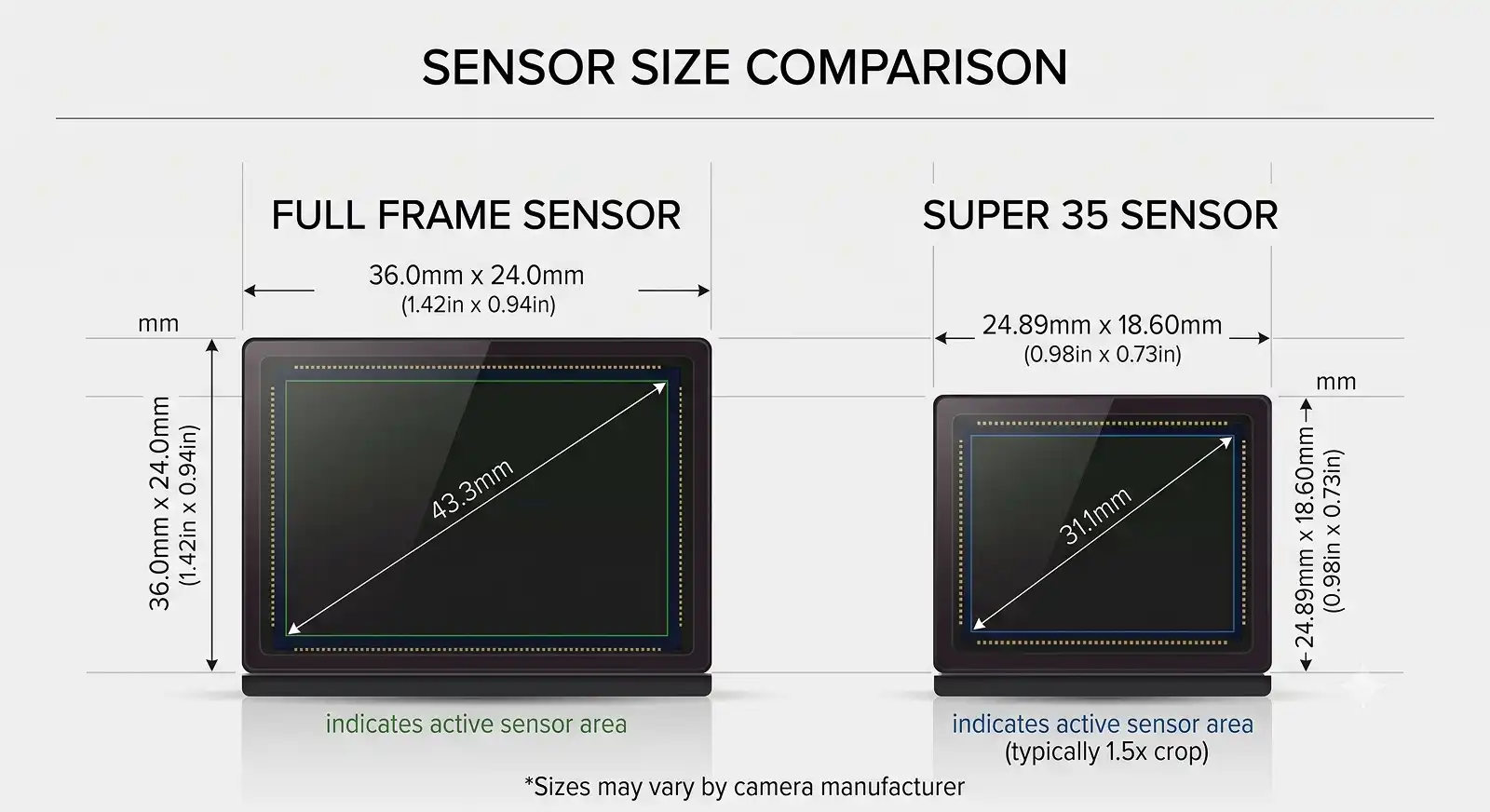
Full frame measures roughly 36 by 24mm. Super 35 measures roughly 24.89 by 18.60mm, close to a 1.5x crop against full frame, which changes field of view, depth of field, and what lens actually covers the frame. Full frame vs Super 35 is the sensor question we field on almost every enquiry call about our film equipment rental inventory in Spain. Every week a client asks which one to shoot, and the answer depends on the job: commercial, corporate, run and gun, documentary, or social, on the creative brief, and on how the post is planned.
Super 35 Sensor VS Full Frame in Size and Crop Factor
The dimensions are simple enough on paper, but both trace back to the same nominal 35mm film gauge. What changed was how that film ran through the camera.
- Full frame: roughly 36 by 24mm. Stills cameras ran 35mm film horizontally through the gate, exposing a wide frame along the length of the strip. Digital full frame sensors inherited that same active area.
- Super 35: roughly 24.89 by 18.60mm. Cinema cameras ran the same 35mm film vertically through the gate instead, so frame height came from the perforation pitch rather than the strip width, and the resulting frame is a fraction of the stills size. This is the format cinema cameras have used since the days of actual film stock, and the size has barely moved across decades of camera bodies.
Because these two areas differ this much, the crop factor between them runs close to 1.5x. That matters more on set than the spec sheet lets on. A 24mm on full frame is a wide establishing lens. The same 24mm on Super 35 crops in closer to a 35mm field of view.
Three things shift with it. Blocking changes, action planned around a wide frame now reads tighter at the edges. Truck position changes, holding the same wide framing means pulling the camera back further, not just trusting the lens. And the zoom pick for a run and gun setup changes too, a zoom that covers wide to tele on full frame will not hit as wide on Super 35.
The short version: full frame is bigger, roughly 36 by 24mm, with a shallower depth of field and a wider field of view at the same focal length. Super 35 is smaller, roughly 24.89 by 18.60mm, with a narrower field of view, deeper depth of field at the same aperture, and a lighter lens package.
Depth of Field and Low Light: Why Sensor Size Changes the Image
Full frame gives a shallower depth of field and better low light performance than Super 35 at the same aperture and the same framing. Both come down to the same physics: a bigger sensor gathers more light at a given aperture, and that same light gathering is what shrinks depth of field.
Put a full frame body next to a Super 35 body at the same aperture, and the full frame image separates the subject from the background more, with a softer roll off behind it. That falloff is exactly what commercial directors mean when they ask for full frame by name, and it is why full frame is what we reach for on that shallow, cinematic look.
Super 35 does not just concede that shallow look, though. Faster glass closes most of the gap, and a Super 35 body wide open on a T1.5 prime will hold its own against a full frame body stopped down to match a workable focus margin. The difference is real, but it is a difference of degree, not a wall.
Rig Weight and Handling: Where Super 35 Wins on Set
What Super 35 gives up in raw light gathering, it wins back in size and weight. Put a compact zoom on a Super 35 body and the whole rig runs lighter on a gimbal. That matters the moment a job stops being about hitting a mark and starts being about an operator moving through a crowd, or working handheld through an interview that cannot be blocked in advance.
What Full Frame VS Super 35 Means for the Camera Crew
Super 35 lens packages are often lighter and faster to swap, which helps the first assistant camera on a multi setup day with tight blocking. As a rule of thumb, a Super 35 setup also runs lighter for handheld and gimbal work, which means less to carry and rig through a long day. Full frame primes run larger and heavier, and swapping them on a moving rig often takes an extra pair of hands.
The focus puller sees the same split, for a different reason. Full frame’s shallow depth of field takes a steadier follow focus workflow, since the margin for error is thinner at the same aperture. Super 35’s deeper depth of field gives more room to work with, which matters most on fast-moving documentary or run and gun work.
Neither format is a scheduling dealbreaker on its own. It is one more input we factor in when we crew a job.
How Does Lens Selection Differ Between Full Frame and Super 35?
A full frame lens will always cover a Super 35 sensor. A Super 35 lens will never properly cover a full frame sensor. That single rule drives most lens decisions on a shoot, and it comes down to image circle.
Image circle is the actual projected area a lens throws onto the sensor plane, and it decides whether the image covers the full sensor or falls short at the edges. A Super 35 sensor measures roughly 31mm on the diagonal, and a lens built for that format only needs to project a circle wide enough to cover it. A full frame sensor measures roughly 43.3mm on the diagonal, so a full frame lens has to project a wider circle to match, one that already covers Super 35’s smaller area with room to spare.
Put a Super 35 lens in front of a full frame sensor instead and the image runs out before it reaches the corners, showing up as dark, vignetted edges or a hard circular cutoff. There is no fix for it beyond cropping in digitally and losing resolution at the edges. The physically smaller lens simply does not throw enough light far enough to fill the bigger sensor.
Full Frame VS Super 35 Cost: It’s the Lens Package, Not the Body
Per body list price is the wrong comparison, and most online guides stop there. What actually moves the number across a shoot week is the lens package.
A single lens rarely covers a real shoot. Commercial work especially calls for a full set of primes on set, not one focal length carried through the day. That lens package is doing most of the budget work before the camera body even enters the conversation.
High end productions default to full frame prime sets as a rule of thumb, and the image circle math from the last section explains why. A full frame set covers a full frame body and a Super 35 body without buying two separate packages, so it is the safer standing order regardless of which camera ends up on the day. Super 35 only glass can undercut that price precisely because it gives up that flexibility. It only ever covers one format, so a production locks in the format choice the moment it books the lens package, not the camera.
Sensor Size Is Only Half the Decision: Raw Format and Color Science
Every major manufacturer builds genuinely excellent cameras in both formats now. Sony builds the FX30 in Super 35 and the FX3, FX6 and FX9 in full frame. ARRI builds the Alexa 35 and Alexa Mini in Super 35, and pushes past full frame entirely with the larger sensor on the Alexa Mini LF. RED builds the Komodo and Komodo-X in Super 35 and configures the V-Raptor for full frame.
Everything covered so far, light gathering, depth of field, rig weight, still shapes the call. But in a real shoot, the decision rarely stops at sensor size. It also comes down to what happens after the shoot: which raw format the post pipeline is built around, and which camera’s color science actually matches the look the project needs.
Sony, RED and ARRI do not just build different sensors, they process color differently too. Sony’s S-Log3 color science reads clean and neutral straight out of the camera. RED’s IPP2 pipeline is built to be reshaped, giving colorists deep control over the image before a grade even starts. ARRI’s color science is the industry reference point for skin tones, which is why so many productions build their whole grade around it.
A production chasing a specific look for a commercial video production is often choosing a camera brand before it chooses a sensor size at all. Sensor size still narrows the field. Full frame or Super 35 decides what lens package and what crew configuration make sense. But the raw format and the color science decide what the image actually looks like once it reaches a grade.
Full Frame or Super 35? We Stock Both, and Help You Choose
Whichever format your director, agency, or in house team has already specified, we equip and crew for it, lens package, raw format, and color science included.
Not every production comes to us with the format already decided. Corporate video clients especially often need the call made for them, not just the camera booked. That is where we step in as production partners, not just a rental counter. Tell us the look you are after, the delivery format, and where the footage is headed in post, and we will tell you which format and which camera earns its place on the day.
How we equip and crew either format is one piece of the full video production support we run across Spain. Format is a production decision, not a preference. Get a detailed quote and tell us the format your director wants, or let us help you land on the right one.
Full Frame VS Super 35: FAQ
Is Super 35 still used?
Yes. Super 35 remains the native sensor size on most professional cinema cameras. It is still the default for episodic television, documentary, and any job where lens weight and depth of field control matter more than full frame’s low light ceiling.
Are movies shot on full frame or Super 35?
Both. Super 35 has been the default theatrical format since the 35mm film era, and most digital cinema cameras still shoot it natively. Full frame has gained ground over the last decade as cameras like the Sony Venice and ARRI Alexa 65 pushed the format into mainstream production. Super 35 remains the more common choice for episodic television and lower budget features.
Is Super 35 the same as APS-C?
They are close relatives, not the same thing. Both sit near a 1.5x crop against full frame, so lens field of view behaves similarly across the two. But Super 35 is a cinema format at roughly 24.89 by 18.60mm, while APS-C is a stills designation running closer to 23.6 by 15.7mm, shorter in height and a different aspect ratio. Many APS-C lenses will cover a Super 35 sensor in a standard 16:9 crop, but not reliably in open gate.
Can you use Super 35 lenses on a full frame camera?
Not at full sensor coverage. A Super 35 lens projects an image circle of roughly 31mm, and a full frame sensor needs roughly 43.3mm to fill the corners, so the result is heavy vignetting or a visible circular cutoff. Most full frame cinema cameras do offer a Super 35 crop mode, which uses only the centre of the sensor and produces a clean image, at the cost of the resolution the crop discards.
What is the Super 35 crop factor versus full frame?
The crop factor is close to 1.5x. A full frame sensor measures roughly 36 by 24mm against Super 35’s roughly 24.89 by 18.60mm, so a Super 35 sensor captures a narrower slice of the same lens image circle.
What is Super 35?
Super 35 is a sensor size used by most professional cinema cameras, measuring roughly 24.89 by 18.60mm. The name comes from 35mm motion picture film, which used a larger area of the film frame than 35mm stills photography did, and digital Super 35 sensors inherited both the name and the working size.