Written by: Markus Ruf | Founder & Head of Production Solving production challenges across Spain since 2008
After 15+ years of navigating Spanish bureaucracy for international productions ranging from BBC documentaries to Nike commercials, we’ve learned that the film permit process in Spain, while complex, follows predictable patterns once you understand the system.
This guide breaks down everything international producers need to know: which authorities issue permits, what documentation you’ll need, realistic processing times, actual costs by city, and how to avoid the common mistakes that delay productions.
When Do You Need a Film Permit in Spain?
You need a film permit in Spain when your production occupies public space with equipment, crew, or vehicles. Most professional filming requires authorization.
You must have a permit when your production:
Sets up equipment – Placing tripods, lights, dollies, sound gear, or monitoring stations on sidewalks or streets
Uses multiple crew members – Typically 3+ people (Madrid: 15+, Barcelona: 10+, most cities: 3+)
Parks production vehicles – Equipment trucks, crew vehicles, or reserving spaces in public areas
Blocks or redirects traffic – Impacting pedestrian flow or any street closures (even partial)
Films at night – Shoots after 10 PM require special authorization in most cities
Operates drones – All aerial filming needs AESA aviation permits plus municipal authorization
Includes special activities – Pyrotechnics, stunts, animal filming, or crowd scenes with extras
The question isn’t usually “do we need a permit?” but rather “which permits do we need?”. For productions filming across multiple Spanish cities, coordinating film permits with local authorities becomes essential to staying on schedule.
The Basic Rule: Public Space Occupation
Here’s how Spain’s permit system actually works: you can film anything in the public domain without permission, unless you need to occupy public space to do so.
The basic film location permit is called “ocupación de la vía pública”. This isn’t about filming itself; it’s about using public space with your equipment, crew, or vehicles.
While you could technically film handheld while walking down a street without a permit, the moment you set up any equipment or your crew exceeds the local threshold, you’re occupying public space and need authorization.
City-Specific Film Permit Thresholds
Different Spanish cities have different crew size limits for simplified or free permits:
Madrid: Crews under 15 people may qualify for free permits with minimal equipment
Barcelona: Crews under 10 people with handheld cameras may use simplified permits
Most cities: Any equipment placement or crew over 5 people triggers permit requirements
Premium locations require additional permits beyond basic municipal authorization:
Beaches: Municipal permit + Coastal Department authorization (2 separate permits required)
Heritage sites: 2-4 weeks advance notice for UNESCO World Heritage sites and major monuments
Protected natural areas: Environmental permits with 30-60 day processing times
Can You Film in Spain Without a Permit?
The scenarios where you can film without permits in Spain are extremely limited.
You DON’T need a permit when:
Tourist filming – Genuinely filming as a tourist with a handheld camera/smartphone, moving continuously without equipment setup or blocking pedestrian traffic
Simplified notification – In Madrid, crews under 15 people with only handheld cameras and small tripods may qualify for notification rather than full permits (must still notify authorities, cannot impede traffic)
Private property with zero public impact – Filming entirely on private property with owner’s permission, no equipment on sidewalks, no production vehicles on streets (heritage sites and protected areas still require special permits even on private land)
The reality is that most professional productions will need permits. If your shoot involves any equipment setup, multiple crew members, or public space occupation, start the permit process 4-6 weeks before filming.
Understanding Spain’s Film Permit System
Film permits in Spain are issued by municipal governments (town halls), not a single national authority. Different levels of government control different aspects of filming, and each municipality operates independently.
Primary permit authorities in Spain:
Municipal governments (Ayuntamientos) – Issue majority of permits for public space occupation (ocupación de vía pública). Each city has independent procedures and fees.
Regional authorities (Autonomous Communities) – Grant permits for regional parks, heritage sites, and cultural locations within their jurisdiction.
National agencies – DGT (traffic authority) for road closures, ICAA for major international co-productions, AESA for drone operations.
Film commissions – Facilitate connections and navigation but don’t issue permits directly (Madrid Film Office, Barcelona Film Commission, etc.).
Special authorities – Coastal Department (beach filming), heritage site management (monuments), environmental agencies (protected areas).
The municipality where you’re filming issues your primary permit. Additional permits depend on what your production involves.
Why There’s No Single “Spain Film Permit”
Spain’s administrative structure distributes authority across national, regional, and municipal levels, with each layer controlling different aspects of filming. What works in Madrid doesn’t apply in Barcelona, and Seville’s process differs from Valencia’s.
For international producers, this means scouting locations in Spain isn’t just about visual appeal, it’s about understanding which specific authorities control that exact spot. A shoot spanning multiple cities requires separate permit applications to different entities, each with their own forms, timelines, and fees.
Key Permit Authorities by Level
Municipal Level (Town Halls / Ayuntamientos)
Who: Local municipal governments in each city where you’re filming What they issue: Ocupación de vía pública (public space occupation) permits, the fundamental authorization most productions need Authority covers:
Equipment placement on streets and sidewalks
Production vehicle parking in public areas
Crew presence in municipal spaces
Local police coordination for shoots
Night filming authorization
Processing time: 5-21 working days depending on city (Madrid: 7-15 days, Barcelona: 5 days, Valencia: up-to 30 days, Seville: 10 days) Key detail: Each municipality operates independently with unique procedures, fee structures, and requirements. Larger cities have dedicated filming bureaus; smaller towns handle permits through general administrative offices.
National Level Agencies
DGT (Dirección General de Tráfico – Traffic Authority)
Under the Ministry of Interior, DGT manages road policy across Spain. Required when filming involves road closures, traffic regulation, or affects major roadways.
Authority: Traffic management and road closures nationwide
Processing time: +15-20 working days (in addition to municipal permits)
Operates through: Provincial offices across Spain
Triggers: Any filming affecting highway traffic, major road closures, tracking shots on roads
ICAA (Institute of Cinematography and Audiovisual Arts)
Attached to the Ministry of Culture and Sport, ICAA handles film funding, grants, and industry policy rather than routine permits.
Authority: Film company registry, major international co-production licensing
Relevance: Primarily for large international features and official co-productions
Note: Most permit work happens at municipal level, not through ICAA
AESA (Spanish Aviation Safety Agency)
Issues drone operation permits for all aerial filming.
Authority: Aviation permissions for drone operations
Additional: Municipal permits still required even with AESA approval
Regional Level (Autonomous Communities)
Spain’s 17 Autonomous Communities have jurisdiction over regional matters, including cultural affairs and some filming permissions.
When regional permits are needed:
Filming in regional parks and natural areas
Heritage sites under regional management
Productions affecting regional infrastructure
Beach filming (regional coastal departments)
Regional film commissions: Many regions operate commissions that facilitate productions and coordinate with local authorities (Andalusia Film Commission, Catalonia Film Commission, Valencia Film Office, etc.).
Film Offices and Commissions
What they are: Facilitation services, not permit-issuing authorities Their value: Navigation expertise and local knowledge, not regulatory authority.
Many international productions work with local video production companies in Spain who coordinate directly with both film commissions and municipal authorities, handling the entire permit process in Spanish.
Additional Location-Specific Filming Authorities
Coastal Department (Demarcación de Costas)
Authority: Beach and coastal area filming
Required for: Any filming on beaches or within maritime-terrestrial zone
Processing time: 15-20 working days
Note: Required in addition to municipal permits
Heritage Site Management
Authority: UNESCO World Heritage sites, major monuments, historical buildings
Processing time: 2-8 weeks depending on site significance
Examples: Real Alcázar Seville, Alhambra Granada, Sagrada Familia Barcelona
Note: Each site has independent approval process and location fees
Environmental Agencies
Authority: National parks, protected natural areas, nature reserves
Proof of payment (permit fees, varies €50-600+ by city)
Additional documents when required:
Property owner permissions (private locations)
Traffic management plans (street closures)
Risk assessments (stunts, special effects)
Drone operator license (AESA certified)
Environmental permits (natural areas)
Heritage site authorizations (monuments)
All documents must be in Spanish or officially translated.
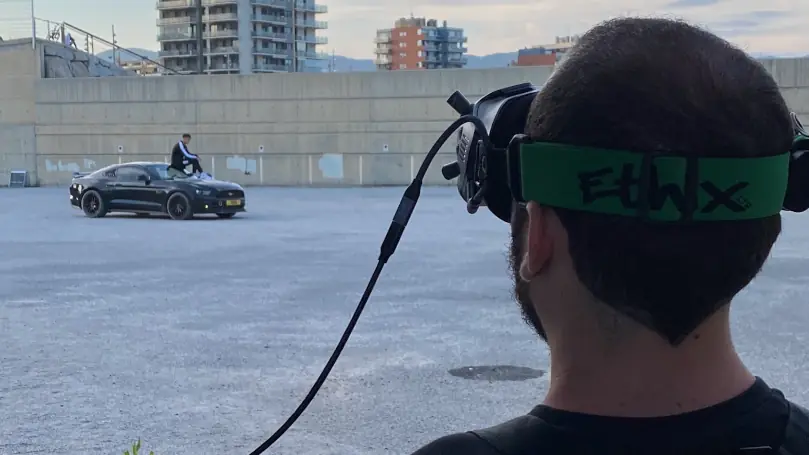
Licensed FPV drone filming in Spain — AESA permit secured
What Types of Film Permits Exist in Spain?
Spain requires different permit types depending on your production location and activities. Most productions need at least one municipal permit, with additional authorizations for specialized filming.
Main film permit types in Spain:
Public Space Permit (Ocupación de Vía Pública) – Basic authorization for equipment and crew on streets/sidewalks (required for most shoots)
Traffic and Road Closure Permits – Additional authorization when affecting vehicle or pedestrian flow
Beach and Coastal Permits – Dual permits from municipality and Coastal Department
Heritage Site Permits – Special authorization for UNESCO sites and monuments
Protected Natural Area Permits – Environmental permits for national parks and reserves
Night Filming Permits – Special authorization for shoots after 10 PM
Animal Filming Permits – Health department approval for productions involving animals
Most productions need permits from multiple categories. A beach shoot with drones, for example, requires municipal + coastal + drone permits – three separate applications.
Basic Public Space Permit (Ocupación de Vía Pública)
This is the foundation permit most productions need. It authorizes you to occupy public space – streets, sidewalks, plazas – with equipment, crew, and vehicles.
What it covers:
Setting up cameras, tripods, and lighting equipment on public streets and squares
Crew members working in public spaces
Production vehicles parked in designated areas
Equipment staging zones
Who issues it: Municipal governments (town halls/ayuntamientos) through filming authorization bureaus or general administrative offices
Processing time: 7-15 working days for standard requests in major cities (smaller municipalities may take longer due to less frequent processing schedules)
Typical costs:
Madrid: €48.65 administrative fee + €0.58 per linear meter per day
Barcelona: €38.36 issuing fee + €593.78 per day for commercial productions
Smaller cities: Often lower fees or free permits for small crews
Key detail: This permit doesn’t authorize traffic closures, beach filming, or special activities (those require additional permits).
Traffic and Road Closure Permits
When filming affects traffic flow beyond basic equipment placement, you need additional permits from traffic authorities.
When required:
Street closures (full or partial)
Redirecting vehicle or pedestrian traffic
Filming on major roads or highways
Tracking shots involving moving vehicles
Reserved parking beyond standard production vehicle needs
Who issues it:
DGT (Directorate General for Traffic) for major roads and highways
Regional traffic departments for regional routes
Local police coordination for municipal streets
Guardia Civil for highway filming
Processing time: 15-20 working days minimum (longer for complex closures affecting major thoroughfares)
Additional requirements:
Detailed traffic management plans
Coordination with local police
Traffic control personnel (often required)
Higher insurance coverage amounts
Cost impact: Traffic permits typically add €200-500+ to base permit costs, plus personnel fees if traffic control required.
Beach and Coastal Filming Permits
Beach filming requires layered permits from multiple authorities, you can’t get just one authorization for coastal locations.
Required permits:
Municipal permit – For areas above the shoreline (beach access, parking, crew staging)
Coastal Department authorization – Demarcación de Costas controls the beach itself (the maritime-terrestrial zone)
Environmental permit – If filming within protected coastal areas
Processing time:
Municipal permits: 7-15 working days
Coastal Department: 15-20 working days
Environmental permits: 30-45 days
Who issues it:
Municipal government (basic authorization)
Demarcación de Costas (Ministry of Environment coastal department)
Regional environmental agencies (if in protected areas)
Typical costs: €300-600 total for municipal + coastal permits combined
Critical timing: Start beach permit applications 6-8 weeks before filming to account for multiple sequential approvals.
Drone Filming Permits
All aerial filming in Spain requires aviation authority permits plus municipal authorization.
Municipal filming permit for takeoff/landing locations
DGT coordination if overflying highways
Requirements:
Licensed drone operator (AESA certified)
Detailed flight plans with coordinates
Drone liability insurance
Compliance with no-fly zones (airports, government buildings, certain urban areas)
Who issues it:
AESA (Agencia Estatal de Seguridad Aérea) for aviation approval
Local municipality for ground operations
DGT if filming involves highways/major roads
Processing time: 10-15 working days for AESA permit
Important: Even with AESA approval, you still need municipal permits for your crew and equipment on the ground. Drone permits don’t replace basic filming permits.
International productions filming aerial footage across Spain often hire local camera crews with drone certification who handle both AESA permits and ground crew coordination.
Heritage Site and Monument Permits
UNESCO World Heritage sites and major monuments require special authorization beyond standard municipal permits.
When required:
UNESCO World Heritage sites
Major monuments and historical buildings
Museums and cultural institutions
Protected architectural sites
Examples:
Real Alcázar (Seville)
Alhambra (Granada)
Sagrada Familia (Barcelona)
Plaza Mayor (Madrid)
Historical Old Towns
Who issues it:
Site management or institutional authority (each site has independent approval process)
Regional cultural departments (for regional heritage)
Municipal permits still required in addition
Processing time: 2-8 weeks depending on site significance and bureaucratic complexity
Typical costs: €500-3,000+ in location fees (beyond basic permit fees)
Restrictions:
Limited filming hours (often outside public visiting times)
Equipment restrictions (no heavy gear that could damage site)
Crew size limitations
Advance approval of exact filming plans
Key detail: Heritage site approval is separate from and additional to municipal permits, budget time for both.
Protected Natural Area Permits
National parks, nature reserves, and protected environments require environmental permits from regional authorities.
When required:
National parks
Nature reserves
Protected forests and mountain areas
Areas with environmental protections (even on private land)
Who issues it: Regional environmental agencies (Autonomous Community environmental departments)
Processing time: 30-60 days
Requirements:
Environmental impact assessments
Justification of filming necessity in protected area
Compliance with seasonal restrictions (breeding seasons, fire risk periods)
Crew size limitations
Equipment transport restrictions (no heavy vehicles in sensitive areas)
Costs: €200-800 depending on location sensitivity and required assessments
Seasonal restrictions: Many areas prohibit filming during bird nesting seasons (spring/summer) or fire risk periods (summer/autumn).
How to Apply for a Film Permit in Spain: 6-Step Process
Applying for film permits in Spain follows a consistent process across most municipalities, though specific requirements vary by location. Here’s the practical roadmap we’ve refined through 500+ permit applications since 2008.
Identify the Authority
Determine which municipality manages your filming location
Contact local Town Hall filming bureau or Film Commission
Confirm specific requirements and processing times
Check if you need permits from multiple authorities
Make location maps with equipment placement diagrams
Submit Complete Application
Submit via online portal or municipal registry
Use clear file naming (Production-Name_Insurance_2026.pdf)
Request confirmation of receipt
Get your assigned permit coordinator’s contact
Pay Required Fees
Administrative fee: €38-50
Public space occupation: €50-600+ depending on city
Additional services (police, traffic control) if needed
Don’t assume processing starts without payment confirmation
Receive and Review Permit
Check authorized locations match your needs
Verify approved dates and filming hours
Confirm permitted crew size and equipment
Request amendments immediately if anything is incorrect
Comply During Production
Keep printed permits visible on location
Stay within authorized hours, locations, crew size
Coordinate with local police if required
Clean and restore locations after filming
Special Considerations for International Productions
International producers face additional practical challenges: most permits are in Spanish (have someone review all documents thoroughly), municipal offices operate 9 AM – 2 PM Spanish time (plan communication accordingly), international bank transfers for fees take 3-5 business days (use Spanish bank accounts when possible), home country insurance may not be accepted (arrange Spanish-issued or EU-recognized policies), and if you’re not physically in Spain, authorize a Spanish representative through power of attorney to apply on your behalf.
When to Hire a Production Service Company
Consider professional permit assistance when:
You’re filming in multiple Spanish cities (different permit systems)
Your shoot involves complex authorizations (drones, heritage sites, road closures)
Time is tight and you need error-proof processing
You don’t have Spanish-speaking staff
Your production is high-value and can’t risk permit problems
Production service companies in Spain who handle permits daily know which municipalities process applications faster, which locations have hidden fees, and how to structure applications for fastest approval.
We’ve handled 500+ permit applications across Spain and know which municipalities require extra documentation and how to navigate unexpected complications. The permit process seems bureaucratic, but it’s manageable with proper planning, complete documentation, and early start dates.
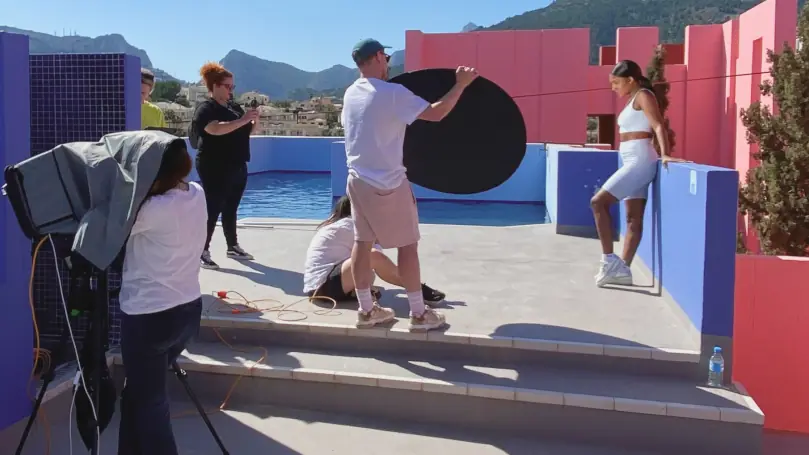
Filming at Muralla Roja, Calpe — permits handled by Camera Crew Spain
How Much Do Film Permits Cost in Spain? [2026 Pricing]
Film Permit Cost Overview
Film permit costs in Spain vary significantly by location, production type, and scope. Unlike some countries with standardized national rates, Spain’s decentralized system means each municipality sets its own fee structure. Here’s what international productions need to budget.
Understanding Spain’s Varied Fee Structure
Spain has no single national fee system for filming permits. Each municipality, autonomous community, and managing authority establishes independent rates. What costs €50 in one city might cost €100 in another for the same type of shoot.
Fees depend on multiple factors:
City size and popularity
Commercial vs. non-commercial production
Crew size and equipment
Filming duration and hours
Public space impact
Specific location prestige
Major cities like Madrid and Barcelona charge higher fees due to administrative demands and location popularity. Smaller municipalities often have lower fees or even free permits for minimal-impact productions. Tourist hotspots and heritage sites command premium rates.
Administrative/Issuing Fees
Base fee for permit application processing, charged regardless of production size.
Typical costs:
Madrid: €48.65 for large crew permits
Barcelona: €38.36 for specific permits
Smaller cities: €35-50 per application
Small crew permits: Often free if meeting size/equipment restrictions
What it covers: Application processing, permit document preparation, coordination with relevant departments
Payment timing: Usually required upfront before permit processing begins
Public Space Occupation Fees
Charged for physically occupying streets, sidewalks, and plazas with equipment and crew.
Calculation methods vary by city:
Per linear meter per day (Madrid: €0.58/meter/day)
Flat daily rate (Barcelona: €593.78/day for commercial productions)
Per square meter (some smaller municipalities)
Cost factors:
Size of occupied area
Location prestige (major plazas cost more than residential streets)
Production type (commercial vs. non-commercial)
Duration of occupation
Location-Specific Fees
Premium locations command higher rates. Major streets, historic plazas, and landmarks cost more than residential neighborhoods. Barcelona’s parks and gardens charge €593.78 daily for commercial filming. Heritage sites often charge substantial location fees beyond standard permit costs, ranging from hundreds to thousands of euros depending on the monument’s significance.
Beach filming requires multiple permits with cumulative costs. Municipal permits plus Coastal Department authorizations can total €300-600. Protected natural areas add environmental permit fees ranging €200-800 depending on location sensitivity and required environmental impact assessments.
Additional Service Fees
Productions requiring extra municipal services pay accordingly: local police presence for traffic control, street cleaning services after filming, traffic management and road closures, parking reservations beyond standard production vehicles, and electricity or water supply connections. These services can add €100-500+ daily depending on requirements.
Commercial vs. Non-Commercial Productions
Spanish cities charge dramatically different rates based on production type.
Commercial productions include:
Advertising and branded content
Corporate videos
Music videos for commercial release
Content for profit-generating platforms
Promotional materials for businesses
Non-commercial productions include:
Documentary films (cultural/educational value)
Student films and academic projects
Independent films (non-profit distribution)
News coverage and journalism
Cultural/artistic projects
Cost-Saving Strategies
Strategic location selection:
Film in smaller municipalities with lower fees when possible
Use free permit zones (some cities offer film-friendly areas)
Schedule residential neighborhood shoots (lower occupation fees than city centers)
Production structure optimization:
Keep crew under threshold for free permits when possible (Madrid: 15, Barcelona: 10)
Minimize equipment footprint to reduce occupation fees
Combine multiple scenes in single location to reduce permit applications
Professional services value:
Professional filming permit services typically charge €300-800 per permit application. While this seems like added expense, experienced companies often save money by:
Knowing which locations offer better value for similar aesthetics
Navigating exemption applications successfully (can save hundreds)
Preventing costly application rejections and resubmissions
Negotiating with authorities for optimal rates when possible
For international productions unfamiliar with Spain’s 8,000+ independent municipal systems, the investment in local expertise frequently pays for itself through avoided mistakes, optimized location choices, and faster approvals.
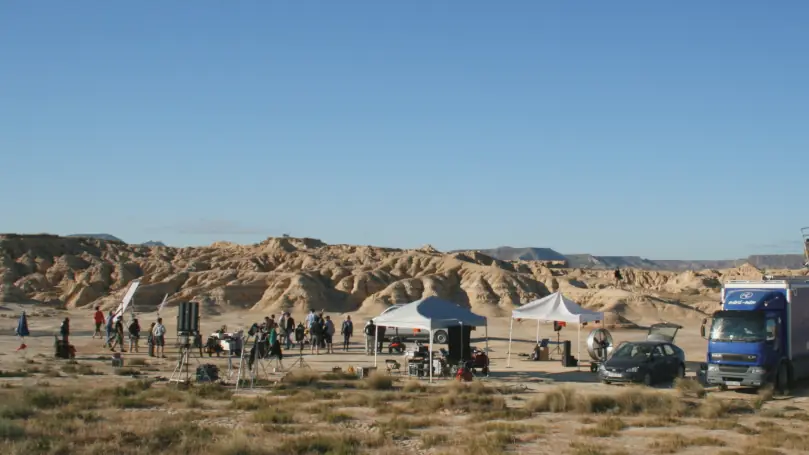
Full production setup in the Tabernas Desert, Almería — location permits coordinated by Camera Crew Spain
Regional Differences: Film Permits by City
While Spain follows similar permit principles nationwide, each major city has distinct requirements, processing systems, and fee structures. Understanding these regional variations helps you plan timelines and budgets accurately for your specific filming locations.
Film Permits in Madrid
Madrid operates a two-tier permit system: free announced action permits for crews under 15 people using only a camera and tripod, and standard occupation permits costing €48.65 plus €0.58 per linear metre per day for larger productions. Processing takes 7 working days for most locations, and 15 working days for parks, gardens, and the Centro and Salamanca districts. All permits are issued through the centralized Filming Authorizations Bureau.
Barcelona operates a two-tier system: a free Basic Authorisation for crews under 10 people with one tripod and no vehicles, processable in as little as 24 hours (the fastest turnaround in Spain’s major cities). Larger productions require an Occupation Licence with a non-refundable €89.59 issuing fee plus €480 per day for public space occupation. Parks, gardens, beaches, and iconic locations like Sagrada Família and Park Güell each require separate permits through additional authorities. All permits are issued by the Ajuntament de Barcelona.
Valencia requires a minimum 30 calendar days lead time. Any production that fences off public space, impedes traffic, or has a crew over 10 people must apply through the city’s Electronic Office, which operates in Spanish only with no English interface. Commercial productions pay €2.33 per square metre per week; documentaries and informative productions could be exempt.
Seville operates a two-tier system managed by Sevilla Film and Events as a single point of contact: a Communicated Act for crews up to 15 people using handheld cameras or occasional tripods (48 working hours processing), and a General Filming Permit for everything else (5–10 working days). The key complexity is sequential: occupation and traffic permits cannot be submitted until the General Filming Permit is already on file. Commercial productions pay €3.39 per square metre per day (minimum €127.07/day).
Beyond the four major cities, regions like Andalusia (Granada, Málaga), Basque Country (Bilbao), and the Balearic and Canary Islands each have distinct permit requirements coordinated through regional authorities.
Multi-region productions benefit from experienced production services that manage consistent permit applications across Spain’s varied municipal systems.
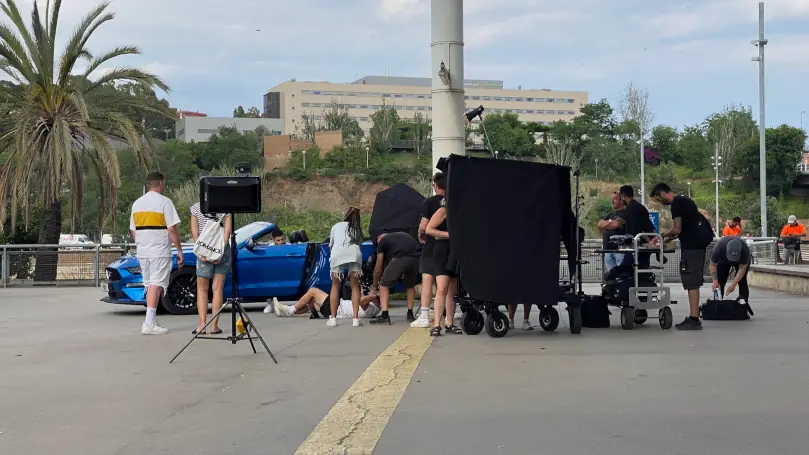
Multi-location film permits for a Puma video production
What Are the Most Common Film Permit Mistakes in Spain?
After handling 500+ permit applications across Spain since 2008, we’ve seen the same mistakes derail international productions repeatedly. Most are preventable with proper planning and understanding of how Spain’s permit system actually works.
Top mistakes international producers make:
Starting too late – Applying 2-3 weeks before filming when 6-8 weeks is needed
Assuming small crews don’t need permits – Setting down a tripod usually triggers permit requirements
Wrong insurance format – Using non-EU insurance that Spanish authorities reject
Not understanding multiple permit requirements – Beach shoots need 3 separate permits, not one
Confusing film commissions with permit offices – Commissions guide but don’t issue permits
Not accounting for local festivals – Filming during Semana Santa or La Mercè faces restrictions
Language and translation issues – Submitting English documents without official translations
Underbudgeting permit costs – Seeing “€50 fee” but actual cost is €500+ with all components
Most permit problems stem from treating Spain as a single system when it’s actually 8,000+ municipalities with independent requirements.
What Happens If You Film Without a Permit
Filming without proper permits in Spain can result in immediate production shutdown by local police, fines ranging from €300 to €3,000+ depending on the municipality and violation severity, potential equipment confiscation until fines are paid, and difficulties obtaining future permits as municipalities track non-compliant productions. Spanish authorities actively monitor popular filming locations and respond to resident complaints, particularly in tourist areas and heritage sites.
For international productions, violations can also affect your production company’s reputation with Spanish film commissions and local authorities, making future shoots in Spain significantly more complicated and expensive. The risk isn’t worth the cost savings; legitimate permits protect both your production and Spain’s public spaces.
Get Your Spanish Film Permits Handled by Experts
Since 2008, we’ve secured 500+ film permits across Spain for international productions from BBC, Discovery, Nike, Samsung, and major brands who trust us to handle the complexity so they can focus on creating great content.
This website uses cookies so that we can provide you with the best user experience possible. Cookie information is stored in your browser and performs functions such as recognising you when you return to our website and helping our team to understand which sections of the website you find most interesting and useful.
3rd Party Cookies
This website uses Google Analytics to collect anonymous information such as the number of visitors to the site, and the most popular pages.
Keeping this cookie enabled helps us to improve our website.
Please enable Strictly Necessary Cookies first so that we can save your preferences!