Spain is one of Europe’s most filmed countries, and drone footage has become a routine part of professional video productions: corporate films, branded content, sports coverage, live events. The locations are exceptional, the light is reliable, and aerial shots of Barcelona, Madrid, Seville or the Spanish coastline deliver results that are hard to replicate anywhere else on the continent.
Getting that footage legally, though, requires navigating a regulatory framework that has changed substantially in the last two years. Royal Decree 517/2024 overhauled Spain’s airspace zone rules in June 2024, and at the end of 2025 Spain retired its national operator approval framework in favour of stricter EU-level standards.
For international productions planning shoots in Spain in 2026, this guide covers what the current rules actually require.
Pre-Shoot Drone Compliance Checklist
After years of managing aerial operations across Spain, these are the compliance steps we make sure are covered before any drone goes up. Nothing gets missed, nothing gets assumed.
Confirm the operational category for all planned shots. Most commercial work will be Specific category;
Verify the operator’s AESA registration is current, including the expiry date on the certificate itself;
Confirm the AESA operational authorisation for the specific shoot is in hand, this is the permit for the operation itself, separate from the operator registration and pilot certificate;
Confirm pilot certification is valid under the 2026 framework. STS-ES expired in December 2025;
Check the ENAIRE Drones app for permanent and temporary restrictions at every planned location;
Submit the Article 40 Ministry of Interior notification for any urban location. This is mandatory for all drone operations in urban areas regardless of category, minimum 5 working days before the shoot;
Confirm civil liability insurance is in force and covers commercial aerial operations specifically;
Verify the operator registration number is visibly affixed to the drone and that Direct Remote Identification is active and broadcasting the correct registered data;
Check whether any location requires additional authorisation: national park, heritage site, critical infrastructure or military zone;
For night shoots, confirm the AESA night flight authorisation is in hand before travel;
Re-check ENAIRE for NOTAM and temporary restrictions in the 48 to 72 hours before shoot day.
These steps cover the aerial compliance layer only. Ground-level filming permits in Spain for location access, public space occupation, and heritage or park authorisations run through separate authorities on separate timelines.
Is It Legal to Fly a Drone for Commercial Purposes in Spain?
Yes. Drone use for commercial video productions is legal in Spain. The body responsible for regulating it is AESA (Agencia Estatal de Seguridad Aérea), Spain’s civil aviation authority. AESA operates within the broader EU framework set by EASA, and the current Spanish rules are established in Royal Decree 517/2024, in force since June 2024.
One thing worth clarifying upfront: the current framework no longer separates recreational from commercial flights as the basis for regulation. Risk level determines the rules, not the purpose of the flight. In practice, any professional video production, whether it’s a commercial video production, a corporate film, a live event, or branded sports content, will almost always involve conditions that require explicit authorisation from AESA. That is the reality this guide addresses.
What Category Does Commercial Drone Filming Fall Under in Spain?
Understanding which category your drone operation falls into is the starting point for everything else. Under EU and Spanish regulations, all drone flights in Spain are classified into one of three categories based on the risk level of the operation:
Open category: low-risk flights. No prior authorisation needed, but operator registration and basic pilot certification still apply. Covers drones under 25kg flying within visual line of sight, below 120m, and away from crowds and no-fly zones.
Specific category: medium-risk flights. To operate in this category you need either a formal permit from AESA, obtained through a risk assessment process, or a declaration that your operation complies with an approved European Standard Scenario. In practical terms: you need documented approval from AESA before the drone goes up. This is where most commercial video shoots in Spain land.
Certified category: high-risk operations such as transporting people or dangerous goods. Not relevant for professional video production.
The practical conclusion: if your shoot involves urban locations, people in frame, sports venues, event spaces, rooftops or coastlines near populated areas, you are almost certainly operating in the Specific category. That documented AESA approval shapes every compliance step that follows.
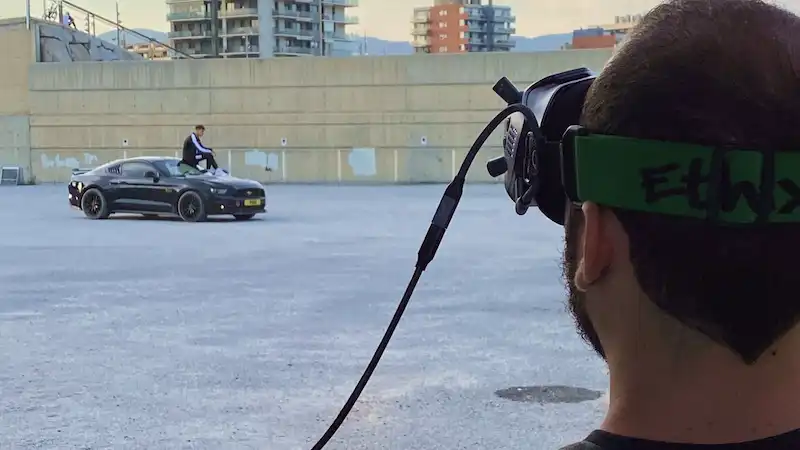
Licensed drone operator during a Puma commercial production in Barcelona. Camera Crew Spain coordinated the aerial filming, AESA permits and location authorisations for the shoot.
Flying a Drone in Spain: What Registrations and Permits Do You Need?
Any drone with a camera or weighing 250g or more requires AESA operator registration before it can fly legally in Spain, and since most professional video productions operate in the Specific category, there are two other separate things that need to be in order to fly a drone legally:
Operator registration: whoever owns and is responsible for the drone operation, whether a production company or an individual, must be registered with AESA. Registration is free, done online through AESA’s operator registration portal, and produces a number that must be physically affixed to every drone operated under that registration. Valid for three years. An expired number means the drone is legally unregistered regardless of everything else being in order.
Remote pilot certificate: the person physically flying the drone needs a valid competency certificate for the Specific category. For operations under the European Standard Scenarios (STS-01 or STS-02), this means holding a Level 3 STS certificate, which requires passing a theoretical knowledge exam and completing accredited practical training for the specific scenario. The pilot and the operator can be two different people: a production company as the registered operator, a hired drone pilot as the remote pilot, but both need current documentation.
Operational authorisation: for Specific category operations, this is the permit for the shoot itself, separate from the operator registration and the pilot certificate. It is documented AESA approval for the specific operation. Without it, the shoot is not legal regardless of how registered or qualified the operator and pilot are.
What operational authorisation actually looks like in 2026
This is where things changed significantly at the end of 2025, and it is worth understanding clearly.
Spain used to run its own national approval system for Specific category drone operations. Operators would file a declaration with AESA referencing one of Spain’s national standard scenarios, and that covered them. That system was retired on 31 December 2025. AESA stopped accepting new declarations under it in August 2024, and all existing ones expired at the end of the year.
What replaced it is the EU-level framework, which offers two standard scenarios called STS-01 and STS-02. These are valid in Spain, but they require drones with specific EU class markings (C5 and C6 respectively for Specific category) which are newer hardware that most operators do not yet own.
The practical result is that for most commercial shoots in Spain in 2026, the realistic compliance route is a full individual AESA authorisation for the specific operation. This involves a risk assessment process, is more involved than filing a declaration, and takes time to obtain. It is not a same-week process.
For productions based outside the EU: if your company or drone operator is based outside the EU, your home-country registration and pilot certificates are not valid in Spain. You need to register directly with AESA before the shoot in Spain. The process is done online but requires setting up access through a separate identification system for foreign individuals first, which takes time. Plan for at least a few weeks since it is not something you can resolve on arrival.
If your operator is based in another EU country, their home registration and certificates are valid for Open category operations in Spain. For Specific category work they need to follow the cross-border operations procedure with AESA before the shoot.One more practical point: AESA’s registration procedures and most official processes are in Spanish only, a concrete reason to work with a local video production company in Spain who handles these regularly.
Where You Can and Cannot Fly: Understanding Spain’s Drone Zones
The only authoritative source for drone no-fly zones, flight restrictions and temporary limitations in Spain is the ENAIRE Drones application. Check it before every shoot day. Temporary restrictions for events, VIP visits and public gatherings can appear at short notice. Manufacturer apps such as DJI Fly Safe are not a substitute for ENAIRE.
Spain’s geographical zone system is defined in Chapter V of Royal Decree 517/2024. There are different types of general zone, each with different requirements:
Military and defence zones: any location near military installations, bases or training areas. Operations only with prior express permission from the responsible authority.
Critical infrastructure zones: such as power lines, pipelines, telecoms masts, transport hubs and ports. They have defined protection volumes around them that drones cannot enter without authorisation. Permission from the infrastructure owner or manager is required before any flight. Relevant for industrial productions, energy sector shoots and harbour or port locations.
Urban environment zones: this is the zone type that catches out most international productions, and it applies to every city shoot regardless of drone size or operational category. Under Article 40 of Royal Decree 517/2024, any drone operation in an urban area must be communicated to Spain’s Ministry of the Interior at least 5 working days in advance. This is not an AESA permit but it is a separate mandatory notification to a different government body, and it applies whether you are flying a 249g drone or a professional cinema rig. On top of this notification, city shoots in the Specific category require AESA operational authorisation. For any shoot in Barcelona, Madrid, Seville, Valencia or any other Spanish city: the 5-day notification to the Ministry of the Interior is a fixed pre-production step, not optional.
Aerodrome and heliport zones: the old blanket 8km airport exclusion rule has been replaced by variable distances per airport and heliport, all defined in the ENAIRE app. There is no single universal distance that applies everywhere, so better check the specific location every time, and do not rely on memory from a previous shoot nearby.
National parks and protected natural areas: Spain has 16 national parks and numerous additional protected zones. Drone operations in any of these require specific authorisation from AESA before flying. For any production planning outdoor shoots outside city boundaries, location scouting in Spain and ENAIRE zone verification are the same pre-production step. A location that works visually may sit inside a protected zone where aerial access requires specific AESA authorisation.
One practical point worth knowing for city shoots: RD 517/2024 removed the requirement to coordinate with air traffic service providers for operations in controlled airspace, provided the flight stays outside the aerodrome/heliport zone and below 60 metres altitude. Much of central Madrid and Barcelona sits inside controlled airspace due to nearby airports, so this change removes one step from the process for rooftop or low-altitude urban shoots (though the AESA authorisation and the 5-day Ministry of Interior notification still apply in full).
Is Drone Insurance Mandatory in Spain?
The short answer for any commercial video shoot in Spain: yes, treat drone insurance as mandatory.
The current rules introduced by Royal Decree 517/2024 are slightly more nuanced. Insurance requirements were relaxed for low-risk hobbyist flying, specifically private individuals flying small drones in the Open category no longer need insurance in certain situations. For professional video productions, this distinction is largely irrelevant.
Here is what actually applies to professional video shoots:
Any operation in the Specific category, which covers the vast majority of commercial shoots, requires civil liability insurance by law
Most location permits in Spain will ask for proof of drone insurance as a condition of approval
Standard production insurance policies typically require drone coverage to be in place separately
What the policy needs to cover: civil liability for third-party damages arising from the aerial operation. Standard travel insurance does not cover this. A policy bought for recreational flying may not cover commercial use. Before the shoot, verify explicitly that your policy covers professional and commercial aerial operations in Spain, not just that a policy exists.
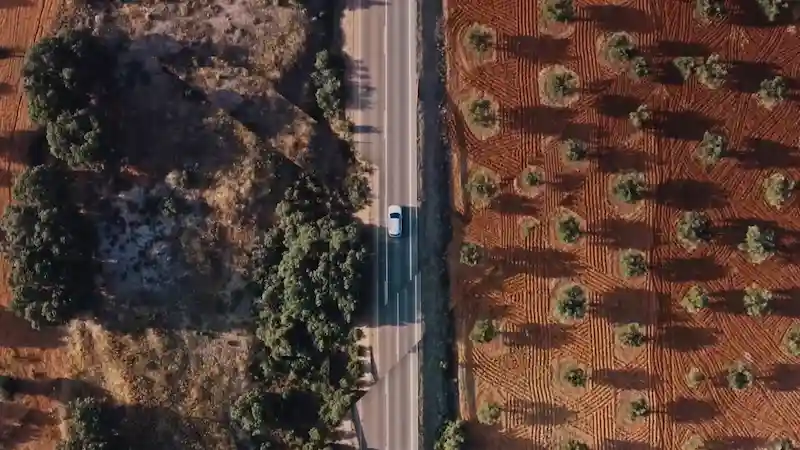
Aerial shot from a BMW and ShareNow commercial filmed outside Madrid. Drone operations and flight permits by Camera Crew Spain.
What Happens if You Fly Without Permits on a Commercial Shoot in Spain?
This is the section that tends to focus minds. The consequences operate at three levels.
Immediate on-set consequences
The more immediate production risk is operational. AESA has enforcement powers under the same law, and Spanish police forces can act on airspace violations on location. The practical consequence of non-compliance is a grounded drone and a halted shoot.
It is also worth understanding how enforcement actually works in practice. Professional drones used on professional video productions are required to broadcast their identity, position and operator data in real time. That signal can be picked up by any compatible receiver, including those used by AESA inspectors and police forces. An unregistered or non-compliant drone is not just visible in the sky but it is broadcasting its own non-compliance.
For a production with a fixed shoot day, a day-rate crew on set and a client deadline, that is almost always more damaging than any permit process would have been.
Financial penalties
Spain’s aviation penalty framework is set out in Article 55 of Ley 21/2003 de Seguridad Aérea (Spain’s Air Safety Law, BOE-A-2003-13616), and it draws a formal distinction between private individuals and commercial operators. The law defines commercial operators as any natural or legal person carrying out activities on a commercial basis or in exchange for economic consideration, which includes any production company charging clients and any drone operator paid for their services.
Infraction severity
Private individual
Professional operator
Minor
€60 – €45,00
€4,500 – €70,000
Serious
€45,01 – €90,00
€70,001 – €250,000
Very serious
€90,01 – €225,00
€250,001 – €4,500,000
Common infractions that trigger these penalties:
flying in a restricted zone
exceeding the 120m altitude limit
no operator registration number affixed to the drone
missing civil liability insurance
failure to submit the Article 40 urban notification.
Broader production and legal exposure
Two further risks sit outside the penalty framework but are relevant to any production creating content for broadcast or commercial use. First, footage recorded without the required authorisations may be challenged for broadcast or commercial release: compliance documentation is increasingly requested by broadcasters, platforms and brand legal teams. Second, data protection law applies separately to any footage capturing identifiable individuals without consent, independently of whether the airspace compliance was in order.
The compliance steps in this guide are not bureaucratic overhead. They are the difference between footage you can actually use and a very expensive day on location.
Working with a Licensed Drone Operator in Spain
For international productions, the most practical route is working with a local production partner who knows the compliance landscape and has the right people in place.
At Camera Crew Spain we coordinate licensed drone pilots who are certified, registered and current under the 2026 framework. We handle the flying and filming permit side of the operation (AESA authorisations, Article 40 Ministry of Interior notifications, ENAIRE checks before every shoot day) so your production arrives on location with everything in order rather than discovering gaps the morning of the shoot.
Our drone systems with licensed operators are available as part of wider production packages, or as standalone aerial crew hire. For full production support in Spain across all locations and shoot types, get in touch with the details of your project.
All regulatory information in this guide is based on official AESA publications and Royal Decree 517/2024. Drone regulations are subject to change. Always verify current requirements at the AESA UAS/Drones section before your shoot.
This website uses cookies so that we can provide you with the best user experience possible. Cookie information is stored in your browser and performs functions such as recognising you when you return to our website and helping our team to understand which sections of the website you find most interesting and useful.
3rd Party Cookies
This website uses Google Analytics to collect anonymous information such as the number of visitors to the site, and the most popular pages.
Keeping this cookie enabled helps us to improve our website.
Please enable Strictly Necessary Cookies first so that we can save your preferences!